Pages

Showing posts with label Theory. Show all posts

Thursday, December 12, 2019

Revisiting the Original GLoG

Lost Caverns of Tsojcanth by Erol Otus

For the last few months, I’ve been running GLoG. Not rat on a stick edition or Mimics and Miscreants, but the original Goblin Laws of Gaming published in the halcyon days of 2016. Since then a tremendous number of GLoG hacks have been written and each has decided to carry forward or abandon elements from Arnold K’s original ruleset. For me it’s been valuable to experience the original rules first hand and see how my players, all new to the OSR, reacted to them. I hope to share what I’ve noticed and bring some less copied parts of the rules into the light of the GLoG-osphere again.

The Numbers

GLoG’s stat generation and its use of stealth and movement stats are used to make the game riskier in specific ways. Rolling 4d4, instead of 3d6, to generate stats lowers the maximum stat one can roll to 16, raises the minimum to 4, and makes it more likely for any stat to be roughly 10. This is a break from tradition but it works well with the roll under rules. Characters with an 18 strength have a slim chance of ever failing a strength roll made on a d20. But characters with 16 strength are still strong but doubly likely to miss their target number. The new equation for deriving stat bonuses has a similar effect, but the calculation is so fiddly that I’d much rather have a table with the values of each stat.

Stealth and movement are also not usually carried into GLoG hacks. They seem a bit redundant, many GMs would much rather have players roll dex. But GLoG wants most characters to be equally good at running away and for the odds of escape to be likely, so the base movement is 12. The same is true of stealth, but the system would prefer players to run instead of hiding, so the base stealth is 9.
Rolling the dice in GLoG is always risky to encourage players to avoid doing so. But the system’s numbers want to make certain actions riskier than others. Making ability rolls should always carry significant risk of failure, but fleeing should naturally be a little more likely to result in success.

Convictions 

I feel like convictions are a good idea but not a great tool. The way Arnold intends them to be used in the original rules makes sense. He wants to encourage more risk taking and role playing, but the application of the rule feels very narrow. Players, in my experience, won’t go very far out of their way to take risks and the conviction system doesn’t do much to help that. The design feels very carrot and stick, it tries to manipulate player psychology without adding much to play. I think I’d like convictions more if there was a table of them so at least players always started with a sense of what motivated their character from the get-go.

In play, I’ve found that convictions are more interesting if they’re used more like inspiration from 5e. If the parameters of what counts as acting to your conviction is broader then players are more interested in looking for opportunities to earn their conviction point. Personally, I like the idea of inspiration being tied more strongly to a particular character motivation instead of being nebulously awarded for good role playing. I, however, see how this approach doesn’t work for every GM’s style.

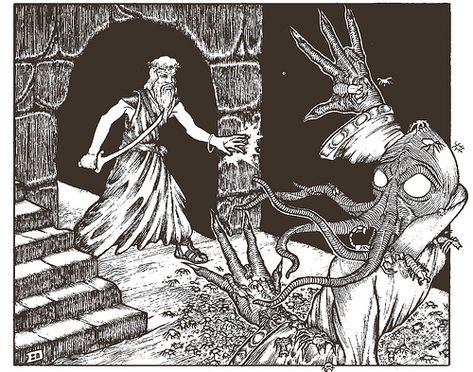
Illithid, Erol Otus, 1980

Skills

The skill system is another clever idea but a poor tool to use at the table. The 2d12 skill rolls and skill progression are interesting but they don’t get a lot of attention in play. The amount of complexity they introduce feels unwarranted.  I’m also not sure about what sort of things skills should cover. The vagueness is freeing, yes, but the guidelines in the rules only tell me what skills should not be, not what they should be. A lot of refereeing for GLoG comes down to enforcing the philosophy behind the rules but there’s almost nothing to go off of here. As a GM, the skill guidelines empower me to say ‘no’ but not ‘yes’ to player suggestions.

Classes

GLoG class design has changed drastically from the original Goblin Guts classes. In my experience, the original classes are a mixed bag. I love the barbarian, whose powers are all unique and uniquely useful, but the acrobat gets a hodgepodge of situational advantages which are nowhere near as interesting. Perhaps it was just my players, but nobody seemed particularly enthusiastic to play any of the original classes. The ingenuity of players is supposed to be more important than the power of their characters and so the classes take a back seat, seem less appealing. I’m perfectly ok with this, but I feel like the classes could use more energy, more interesting tools to use from 1st level. In my game, we started choosing classes randomly from the complete table of GLoG classes, which improved the game noticeably.

The stacking template bonuses are also an interesting feature which has become less popular. Original GLoG characters are supposed to get numerically better in many ways as they level up, their save rises, their attack rises, and another number on their character sheet usually increases as well. There’s a general consensus, I feel, that a broader toolbox is a better reward for leveling up than numerical increases but I feel there’s a good balance to be struck in the middle.

From all this, I think I understand much better why certain parts of the original GLoG rules have not been widely adopted by hacks. Maybe there’s a campaign out there where the original rules all make perfect sense - a game with plenty of temptations for convictions and high risk dungeon crawling – but it is not the game I run. Still, there are parts of the original rules which remain valuable or interesting and have not been translated into hacks.

This post is dedicated to Sam Vimes

Wednesday, July 31, 2019

Cowboys and Conquistadors: Looking for New Models of the Adventurer


Tlaxcalans and Spaniards enter Guadalajara, image from the Lienzo de Tlaxcala

Dungeons and Dragons is about adventurers. A D&D campaign consists of a string of adventures with downtime stretched between them. These ideas didn't come from nowhere. In his 3 part essay, The Sociology of the Murderhobo, Boris Stremlin explores the literary roots of the adventurer, as they are portrayed in D&D, and looks for a model of the adventurer not as a literary archetype but as "a social type" which emerges in early modern history.

In my opinion, Stremlin's essay series is one of the best fruits of the D&D blogosphere. It's articulate but not too inaccessible, well argued, and reveals both the interesting history of D&D and new ways of playing it. Though D&D owes much of its original conception to literature, Boris' analysis suggests that the fantasy of D&D is far from a-historical. The genres which inspired D&D (Weird Fiction, Sword and Sorcery, and Heroic Fantasy) all take influence from the historical and cultural context from which they emerge.

Boris finds that the literary forebears of D&D, in one shape or another, reflect the history of colonialism. The protagonists of Sword and Sorcery are strongly reminiscent of Cowboys from American Westerns. The protagonists of Weird Fiction confront "the immigrant, the politically mobilized but still undereducated industrial worker, the native" as often as they do the cosmic. Though Boris does not touch on the legacy of colonialism and race in Tolkien's epic fantasy, the connection is not difficult to make. (Sidebar: Though James' article explains the history of Tolkien's Orcs well, I feel that he draws too harsh a division between Europe and the steppe. There is a rich and complicated history of interaction between nomadic and sedentary peoples in Eastern Europe.)

All these genres also employ a distinction between a civilized zone, where protagonists hail from, and a frontier where the main narrative action takes place which makes a heavy impression on D&D. In Westerns and Sword and Sorcery this divide is most literal. In Weird Fiction these are frontiers of knowledge as much as physical spaces. The position of Rangers in Tolkien's books attest to a border existing between two civilizations if not between civilization and frontier.

4th edition's so called 'points of light' setting operates on the assumption that the world is composed mostly of "wild, uncontrolled regions" with city states between them. Similarly, in the very title of Gygax's Keep on the Borderlands the same dynamic is represented. There's a Keep, civilization, and the Borderlands, the frontier. Granted, not all D&D settings and adventures maintain a frontier vs civilization theme, but it's telling that this theme stretches from a core assumptions of a modern edition of the game right back to a module intended to introduce new players to it.

Though the legacy of colonialism is certainly sanitized in D&D, it is still present in the game's basic ideas. When we tell stories around the table of civilized heroes venturing beyond the borders to beat back the forces of chaos again and again we should take pause and consider what kind of narrative we are participating in. I'm certainly no less guilty of doing this than anyone else. Boris himself has pointed out how I project the frontier/civilization division onto my own Meager Country.

The connection between D&D and colonialism is also not new. I've begun with Boris' essay but others have reached similar conclusions by different means. But the question remains: in light of this, how should we change the way D&D is played?

 I think we need to base our campaigns off different types of adventurers who are not cowboys or conquistadors and we can find such figures in history. We need to look to the past for new stories, new protagonists, different relationships between 'civilization' and 'frontier.' This effort will not just remove a problematic element from the game but broaden the horizons of what can be represented at the table drastically.

4th Centruy Goth Warriors, Angus McBride

What is an adventurer? 

As Boris describes in the second part of his essay, the early modern adventurer is somebody who manages risk, be they a mercenary, merchant, or financier. The adventurer exists in a time of social change. Established hierarchies are starting to wobble. Great opportunities for disaster and success are emerging. The first adventurers were also the first colonizers. Hernán Cortés, Samuel de Champlain, and John Winthrop fit the word well. But Boris draws our attention to other kinds of adventurers through his discussion of the Ashkenazi Jewish diaspora. This group doesn't appear to be very adventuresome when stood beside the conquistador, but commonalities soon emerge. The Polish-Lithuanian Commonwealth of the 14th-16th centuries, still developing and capable of offering greater religious freedom, is certainly a kind of frontier. Managing a business and setting up a community far way from one's home certainly requires a skill in managing risk. So an adventurer is not necessarily a colonizer and a frontier is not necessarily a terra nullius. 

What we are looking for is this: other conditions under which the adventurer as social type can exist. We are looking for groups of people who choose or are put into situations which require the management of risk to protect their communities or to move up the social hierarchy. These adventurers will also exist in times of change, whose outcome may depend heavily on their choices, failures, and victories. The frontiers they venture to may be states in crisis, far off lands in need of expertise of all kinds, or regions where valuable resources can be obtained.

Here are a few examples of good models of the adventurer, most drawn from the excellent Gundobad Games blog.

The Sea People (and others) of the Late Bronze Age Collapse

The international order of the Late Bronze Age relied on trade and communication between rulers facilitated by mobile populations. Such populations had great power to support or subvert the social order and can be easily seen as adventurers.

The Visigoths of the Late Roman Empire

The Visigoth were one of many groups forced into Rome's borders by the advancing Huns. The Visigoths faced great challenges in the form of corrupt Roman officials and anti-barbarian politicians as they became more and more integrated into the empire. A campaign based on this period would see the player characters adventure to ensure the safety and continuity of their community in exile.

The Vikings of the Viking Age

The Vikings traded, raided, and explored all the way from the White sea to Constantinople and beyond. Driven to win social status back home, pursuing economic advancement, and stimulating change at home and abroad makes the Vikings fit the model of the adventurer almost perfectly.

These are just three examples but in them is an incredible diversity of campaign concepts. I feel like D&D could have been founded on any of them as easily as on fantasy literature. But more remains to be discovered, more models await discovery by game masters who can pay careful attention to history.

This post is dedicated to Marshall Hodgson

Saturday, June 29, 2019

Fall at Old Uppsala - and a Beyond the Fence post mortem


It's done! The first scenario published for Beyond the Fence, Below the Grave is up on itch.io!

You can download it here! 

It's been really fun play testing the system and developing this scenario for it (which, in my honest option, is the best scenario ever written for Beyond the Fence!). Now I have a much better sense of how the system performs. I wrote it partially because I wanted to explore the Old Norse milieu in more detail (and also because of the folklore jam) but also because I wanted to apply OSR design principles to a game without a dungeon. I'd say that it's been a success. The system's rules are flexible and welcome improvisation. The focus on investigation is a good substitute for the dungeon, probably because players succeed in both situations by asking the right questions.

On the whole, I'm impressed by how engaging Beyond the Fence can be for both players and GMs.  The dropping essence scores keeps the tension building. The need to perform a crisis ritual helps the players stay focused. I've had parties fail while running Fall at Uppsala and others succeed and each time it's been a pleasure to watch them bend under the pressure and try to put all the information together at the last minute.

The system needs a good scenario, with high stakes and dense mystery, to function but when it does it's really, really good. If it has a major issue, it's that the system is a one trick pony. It doesn't have a way to make investigation #6 different from investigation #1 and I have no clue what a Beyond the Fence campaign would look like. I'm also worried that I demand too much familiarity with Old Norse society and mythology for the game to be accessible, but I'm trying to remedy that by adding some basic notes on historical context to everything I publish for Beyond the Fence.

Right now, I feel that each of the specialties could use more play testing, but the potential of Beyond the Fence is still great. There are many more parts of the pre-medieval Scandinavian world that I want to represent in the game. I want to explore trading towns and the borders of Saami territory and shores of a just settled Iceland. I want to write about the concubines of jarls and Muslim merchants in the north and about more fishermen and upstart raiders and farmers.

So the first scenario is done, but there are many more to come!

This post is dedicated to Gustav Strom, translator of Heimskringla

Sunday, March 31, 2019

An Introduction to the Viking Age

Illustration by Angus McBride of the death of Olaf Tryggvason
 from "The Vikings" written by Ian Heath 


Luke Gearing has been blogging a little about a Viking campaign and it's got me excited. As readers of this blog may guess, I may have a more than passing interest in Scandinavian culture and the Viking Age. Though Luke is right that going a-viking can provide a strong start to a campaign, I've been constantly disappointed by how the Viking age Norse and their world is imagined in rpgs and in broader pop culture. There's a pervasive obsession with the Norse as a warrior culture, some subconscious idea that the raiding which defined the Viking age was the expression of a people whose primary trait was obsession with the glory of battle.

 At worst, this misconception gives us the Norsca of Warhammer, who are just barbarians who want to tear down civilization and spill blood. At best your Norse-themed fantasy civilizations emulate the aesthetics of Viking age Norse culture without replicating any of the historical context. The Banner Saga series of games is a good example of this trend. What you end up with is a series of symbols, runes, round shields, longboats, which are supposed to stand in for some eternal Viking-ness but only symbolize a wholly modern conception of who the Norse were. Granted, vikings are a popular theme in the tabletop space and there are several games which try to offer a more authentic picture of the Norse. Fate of the Norns and the fairly new Sagas of Midgard all try to offer an authentic Norse-ness in one way or another. However, I am still unsatisfied by these projects. These games want to explore Norse myth, more so than Norse history and in doing so sometimes perpetuate the same misconceptions which give us the Norsca.

While I would love to go into depth about the falseness of the warrior culture myth and the mess of misconceptions which accompany it, I do not think I could muster any argument or evidence able to completely overcome this great specter which haunts Scandinavian/Old Norse/Nordic studies. There is no way I can scoop all the romantic paintings of Thor with his winged helmet and all the modern pictures of Odin with a sleeve of runic tattoos out of peoples' heads with a few idle words. However, I can offer a different vision. I can show you what I find so fascinating, so enthralling about the Viking age. Hopefully, I can convince you that a game inspired by the historical context of the Viking age should be about a lot more than just raiding.

Introduction to the Viking Age

The Viking age (roughly 793-1066 AD) was a time of incredible change in Scandinavia and over its' course all of Norse society would be altered. The Viking age saw the first urban centers emerge where previously all of the region had been rural. It saw the rise of the first kingdoms in Scandinavia, the centralization of power to a degree unheard of before. It saw the creation of great trade routes which connected the White sea to all of Europe, the Eurasian steppe, and to the Islamic world. It saw the birth of new colonies and domains far from where any Scandinavian had previously traveled. And, of course, it saw the introduction and victory of Christianity over paganism which rearranged much of Norse daily life.

But trends don't tell us the whole story, they give us the impression that change occurred at a measured pace instead of in fits and starts. There were, for example, several waves of urbanization which saw trading posts built and abandoned before new ones sprang up. Similarly, the conversion to Christianity advanced piecemeal, with champions of the faith, like Olaf Tryggvason, coming to power and later being deposed.

Trends also don't tell us why things happened. The changes which occurred in Scandinavia were driven by a web of circumstances, actions, and reactions. The success of the Carolingian kingdoms probably inspired Norse rulers to construct the earliest trading towns based on the model of those across the Baltic sea. The settlement of Iceland may have been driven by the higher tax burdens imposed by the first king of Norway, Harald Fairhair, which encouraged many to leave the country. There are many factors which could have lead to the increased range and frequency of raids and increased exploration which defined the Viking age. A warmer climate, a growing population leading to a dwindling amount of land allotted to each son, advances in sailing technology, the previously mentioned political changes, all probably encouraged Scandinavians to reach out to the broader world.

Scandinavians found success as conquers mostly in the same places where their raids were successful. The Baltic sea, the British isles, Eastern Europe, the west coast of Europe were all subject to raids and to a lesser extent the creation of Norse kingdoms and settlements. These Scandinavian founded dynasties would eventually be absorbed by the groups they dominated and frequently came into conflict with each other. The nobility of the Rus states, in what is now Russia and the Ukraine, were Scandinavian in origin but began to take Slavic names as time went on. The Normans, also originally Norse, spoke French by the 11th century and clashed with the originally Scandinavian Saxons for control of England. Though raids are certainly dramatic, most of Scandinavia's connections to the broader world were formed by trade not by violence. Saami and Finnic populations provided many of the furs and walrus ivory which formed the heart of Viking age trade routes. Of course, the Arabs, Byzantines, Irish, Carolingians, and English also played a vital role by providing the demand for goods brought by Norse ships. Both Byzantium and the Abbasid Caliphate were victim to a small number of raids, but all were largely unsuccessful. The only way for the Norse to access the greatest riches of the world was through trade, in fur, in amber, in slaves. These trade routes brought massive amounts of silver and lesser quantities of gold to Eastern Europe and Scandinavia, allowing rulers there to line their pockets and better cement their power. The Byzantines also made use of Scandinavians in a military capacity as guards to the Emperor, though the members of this Varangian guard would eventually stop being sourced from Scandinavia.

The raiding, conquest, exploration, trade, and settlement which defined the Viking age were both the cause of and effect of a web of changing circumstances which originated in Scandinavia and were brought to it, which transformed the homeland of the Norse and the world abroad. Though the Norse did often interact with the world in violent ways, it is critical to note that the majority of the cultural and economic relationships they formed were not. It was age when people and places which had never been connected before were drawn into lasting patterns of encounter and exchange. At the forefront of these budding relationships were people willing to risk life and limb, leave the safety or danger of home behind, to pursue gain in the broader world. It was not just the fiercest warriors who succeeded in the Viking age, but those who had the skills to turn a boat full of furs secured from the Finns in Vipuri, into a boat full of silver in the city of Itil, and finally into an army in Denmark able to take power. But not all needed a throne to be happy. Those who settled down in Iceland, Greenland, were just motivated to find a new home, for some the profit motive must have been a draw, and perhaps the call of a yet unknown world was too hard for some to resist.

But the Viking age would not last forever. There were only so many kingdoms to build, so many beachheads to take, so many rivers that lead to the sea. Some would only realize this when it was too late, once they'd already run aground on great sandbars their boats could not overtake. In 913, stranded in a city in Azerbaijan, a beardless youth from somewhere up north took his own life rather than be captured by the forces of the governor Marzuban ibn Muhammad. The party that the nameless child was part of had occupied the city for months, intending to hold it indefinitely. Things were changing in Scandinavia too. Traditionally, power was held together by familial relationships and promises sworn between charismatic rulers and their supporters, but these foundations of blood and bone were to be replaced by ones of brick and parchment. New institutions were being born in Scandinavia, ones which were much more immune to change. Castles and Churches built side by side would replace the old halls and scared groves. In 1066, in an English field, Harald Hardrada was struck in the throat by an arrow. Harald had adventured across the world for 15 years, amassed great wealth fighting wars for Yaroslav the Wise and Byzantine emperors, before returning to Scandinavia to seek the throne of Norway, Denmark, England. Could he see that the strength of his right hand would not be enough this time? Were he and that anonymous boy aware that an entire age was ending with and around them? 

 Change progresses like the tide, going in and out, but slowly reshaping the coastline. Earth is undermined, then falls away. Grain by grain the sand is replaced. In the long view, from up high, it is clear that there is only a slim chance things could turn out any other way, but on the ground, when it seems each transforming wave could be the last, the outcome is impossible to tell. I think this is how it was for the vikings, the explorers, the merchants. Though many would go unremembered, though many would be dashed against the rocks, they could see the world had given them a chance to reach out and hold their own destiny. The pages of history were yet blank, the mortar was still wet on the stones. This is why I love the Viking age. There was still time to write your name or carve it on the walls of the Hagia Sophia. There were still new lands to see full of new people to meet, new faces to kiss, new fruits to eat which are gathered in no other orchard, and new sunrises to gaze upon.
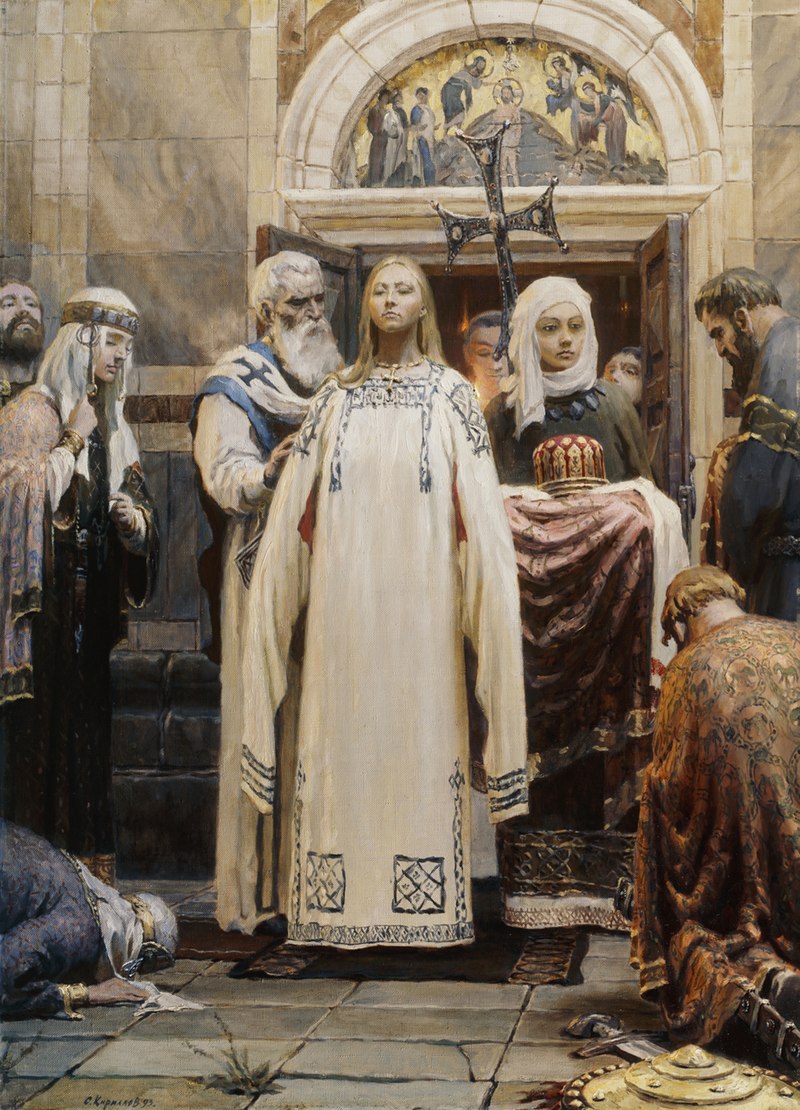
Baptism of St. Princess Olga, Sergei Kirillov, 1993

The Viking Campaign


As we have seen, the Viking age was about a lot more than raiding. If you want to run a proper viking campaign then what matters is not that you preserve a Viking age Scandinavian aesthetic, but play in a world where the historical context of the Viking age is preserved. I wouldn't recommend reproducing the exact circumstances of any decade or century in the Viking age, but rather trying to capture the major and most gamable aspects of the period as a whole. 

The homeland of the player characters should be on the edge of domains which are not immune from raiding or conquest but have superior technology, higher populations, and more centralized authorities. Nearer to the homeland, should be populations able to provide valuable trade commodities (fur, ivory, amber, ect). Forming lasting relationships with these populations can provide steady streams of income, but they'll probably need the party to help them fight their local rivals or send them on a quest. 

Beyond this, the world should be mysterious and mostly unknown. The game's mercantile element should come from having to find the wealthy empires who'll provide the most silver for the party's goods. There will be many trade routes, some dangerous, some full of middlemen looking for tariffs and duties. The elites of the world's empires may also have an interest in the party. Having a group of foreigners with a slightly different attitude towards violence on hand is always useful for those with power. 

 There should also be a kind of adventurer diaspora forming. The party may have rivals who set up kingdoms and settlements close to theirs, compete for access to the same trade routes. The trajectory of the viking game should see the party doing small scale raids and exploratory missions which lead to greater opportunities for profit and eventually transition to more domain focused play, abroad or back in the homeland, in classic old school fashion.    

For players, a viking campaign should be an opportunity to play as a character who is half a rogue trader from Warhammer 40k, a risk taker looking for profit in the unknown, and half Conan the Barbarian, an outsider come to see and judge the heights of civilization.

For GMs, a viking campaign is an opportunity to describe an orange to a character who has never seen one before, to test their player's skills in areas beyond dungeon level problem solving, and to design a political sandbox for players to mess with.

So that's my introduction to the Viking age. I will stress that it is just an introduction. There's a lot more to say about Viking age Scandinavia and its context than what I have presented here is not uncolored by my own reading of history. If you want to learn more about the history of the Viking age, there are many books which serve as deeper introduction to the material than what I provide here. However, I prefer reading the original source material. 'The Viking Age: A Reader' provides a wide variety of sources from many perspectives. I'm a big fan of 'Ibn Fadlan and the Land of Darkness' personally. The doctoral thesis: 'The Rus in Arabic Sources' is also a big influence on the way I see the Viking age. If you want a book with a more rpg focused book, let me recommend 'GURPS Vikings', which does a good job of dispelling common misconceptions about the Viking age.

Thank you for reading this whole thing, hopefully in a few weeks I'll have more details about my own viking campaign  (which will basically be Meager Country v2) ready to show you all.

Hour of the Wolf, Minna Sundberg, 2019

This post is dedicated to that Arch-Lair, that Deceiver, that Great Poet and Preserver: 
Snorri Sturluson

Thursday, February 7, 2019

Meager Country Manifesto

Image result for ibn fadlan
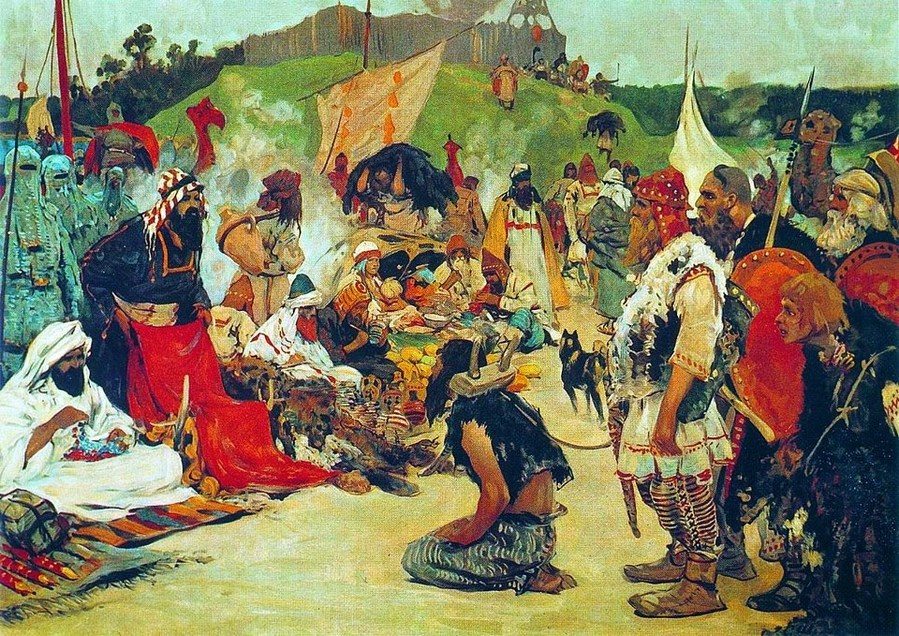
Trade in the East Slavic Camp by Sergei Ivanov, 1913
An image that is always close in my mind when I imagine the Meager Country

As I prepare to run another Meager Country game, I’ve been refamiliarizing myself with the sources that originally inspired the setting. In particular, Ibn Fadlan’s account of his embassy to the Bulhgars as well as the other sources contained in the book “Ibn Fadlan and the Land of Darkness.” Over the course of this exercise, I’ve been reminded of all the things the Meager Country is supposed to capture and all the different directions I could take it. To focus myself, I have written this: My Meager Country Manifesto.

Really, the goal of the Meager Country is to inspire in players a similar sense of danger, strangeness, disgust, fascination, and fear that Ibn Fadlan experienced while meeting the Turks, Bulhgars, Khazars, and especially the Rus. This mix of sensations and the desire to question that goes along with it, I feel, can form the compelling heart of a D&D game.

Of course, Ibn Fadlan is a very unique voice among the small body of documents we have which record the time period I’m interested in. Fadlan’s account is incredibly early (from 922) and he sees things which no other source mentions, like the now classic burning of a Rus leader with his ship.
When other Arabs find themselves in eastern Europe later, such as Abu Hamid al-Andulust al-Gharnati, who started his journey in 1117, almost 200 years after Fadlan, they find a very different world and had very different reactions to it.

Eastern Europe is like a second home to Abu Hamid. There are Muslims and Christians everywhere, the leaders want to learn from Abu Hamid and listen to his shitty poetry. There is nothing to provoke in him that complicated knot of reactions which Ibn Fadlan feels.

In short, I am interested in a time in history that’s as thin as a knife’s edge. The 10th, or maybe even 9th, century which contained a northern world where Islam and Christianity were just beginning to penetrate but had not had any major victories. It was a time when mountains of silver were flowing from Samanid mines onto the Volga to the city of Itil, to the Don river and up, up to Kiev, up to lake Lagoda, up to Birka. Trade was drawing the world together. Alliances between Slavs and Turks and Rus and Magyars with Rome or Constantinople or Baghdad were being formed and faith would cement those fledgling bonds. This is where we find Ahmad Ibn Fadlan, called by the Caliph to bring Islam and 4000 dirhams to Bulgaria.

But the things which moved Ibn Fadlan by their strangeness will not do the same in a modern D&D player. Pluck any person from 10th century Baghdad and show them a Rus merchant and they’ll be seeing something, someone, totally new and unfamiliar. Do the same with a modern RPG player and they’ll just say: “So is this like Vikings or what?”

So Meager Country v2 must be both more historically grounded and more divorced from historical reality. Its world must emulate the political and economic state of the 10th century Arab world, the state which made the journey of Ibn Fadlan to the Bulghars possible, but also be full of new wonders, aja’ib in Arabic, which arouse the same reactions which Ibn Fadlan felt but in the mind of a modern observer.

It’s nice to make nice aesthetic plans but putting them into action, turning them into content is another thing entirely. So what will I do? What will give Meager Country v2 the qualities described above?

1.       Incorporate more Arab beliefs about the far north.
One of the most enduring beliefs about the north in the Arab world was that it was home to Alexander’s Wall, a massive iron gate constructed by Alexander the Great to prevent two races of giants, Gog and Magog, from destroying the world. Such a thing could easily be a ruin left by some fallen civilization, in true OSR style, but it could also be run as a legendary location whose existence is up for debate. I think many of the more eccentric ideas about the north which make their way into Arab sources could be turned into a rumor table and add a layer of doubt to the game.

2.       Add odder folk and folk ways.
I like all the weird kinds of people I wrote for the Meager Country, however I don’t think I emphasized their odd customs enough. I want to get to a point where there’s a sense of culture shock, though I think that might an impossible goal. I should focus more on the strangeness of the different peoples. There should be more odd food, weird rituals players are asked to partake in, more opportunities for faux pas, and I should put players more often in the role of cultural teachers. The Silent Trade will have to mentioned more.

3.       Make travel more dangerous and make stumbling on points of interest more likely.
Though some parts of travel should feel vast and trackless, I want some portions of the game to feature difficult journeys, maybe using wilderness dungeons, or by making use of a deadlier random encounter table. I’d also like to have a high density of interesting locations, maybe by using a few wilderness location tables or just by writing a dense hex map. I could also use some rules for fording rivers.

4.       Focus more on getting from the Empire to the Meager Country
It took Ibn Fadlan a while to just to get to the lands of the Samanids and he visited many cities along the way, he even had to lay low at a little bit. It could be interesting to experiment with starting the campaign as a game about getting the right letters securing passage and greasing the right palms to contrast with the hexcrawling that follows.

5.       Modify what is found in historical sources to create new and evocative content
Just taking things from history is not enough, these ideas must be modified, amended with the fantastic, to strike the tone I want the Meager Country to have. I think that even the fantastic and mythological elements found originally in history should be altered so that some part of them is still unexpected, still unique to the Meager Country.

Now I have a much better idea of what Meager Country v2 should feel like as well as how it will play. It should be a much more player driven game, where there’s less a mission from an imperial authority but just a direction. I think I’ve already been applying some of the above principles, especially #5, but having them written down and codified will help me keep focused on what I want the Meager Country to be as I go forward.

As always, thank you for reading the most idle, content deprived of my musings.

This post is dedicated to Thomas Noonan, who counted coins