Pages

Friday, May 3, 2019

Beyond the Fence, Below the Grave

I've just written and released by own rpg for the folklore game jam on itch.io! 


You can download the pdf from itch.io here

It's an investigative role playing game about practitioners of magic in pre-medieval, pre-Christian Scandinavia. Players are tasked with using their magical abilities to investigate supernatural events, determine what kind of entity is responsible for them, and appease that entity before too many lives are lost.

The game dovetails very nicely with the stuff about Vikings I've been writing recently and tries to get into a side of Old Norse belief which is never portrayed with much depth in pop culture. The lines between mythology and folklore, between magic and religion, did not exist in same way in the Viking age as they do today. Much of people's understanding of these subjects is shaped by Snorri Sturluson, who tried to systematize and organize the mythological stories he recounts, in the Prose Edda and other works, into a cohesive whole. Unfortunately, the shape of belief and religious practice in Scandinavia in the 8th-11th centuries was probably much murkier, more complicated, and very different from region to region. I hope my game can portray a little bit of that murkiness.

Perhaps it would have been helpful for players and dms to add a little bit more historical context and explain some of concepts in greater depth, but I think I've done well with what the page limit provided.

 Anyway, I'd appreciate it if you could download and read my game, maybe throw a few dollars my way, or give me the great honor of running it for yourself (please tell me if you do!)

 I'm planning on releasing new scenarios for the system every month as well, so stick around for that.

This post is dedicated to Lee M. Hollander, whose translation of the poetic edda I still rely on

Monday, April 29, 2019

Treasures from the vault: d20 magic items


Before the pale folk of Beshara conquered the world and brought it under the true light of The Lord, there was an age of darkness. It was an age of tyrant rulers whose cruel rituals edified false deities, the traitor archons who spurned their duty to the eternal kingdom of grace so that they could rule their own domains. All the people of the world suffered in slavery, the goods of their labor were squandered, and all kingdoms were set against each other in bloody struggles for power.

Despite the sorry state of civilization, there was light in this age too. Antiquity has produced some of the most ingenious and wondrous items known on earth, which wizard-artificers in our current age cannot equal. Some of these marvels have been recovered and preserved, while others await discovery in the desert. So come, open the vault and feast your eyes on the treasures of the past which lay within.

Ruins of Balbeck, Miner Kilbourne Kellogg, 1844

1. Cups of Judgment: A silver goblet with the name of a crime engraved on the bowl. Any person who drinks from the cup and has committed the crime written on it is struck dead as soon as the liquid passes their lips. The cup is obviously magical and has a judgmental aura. The cup has a conservative disposition and there are rumors that a ritual exists which can change the crime written on the cup. Most cups have one of these crimes written on them to begin with:
1. Murder
2. Adultery
3. Treason
4. Blasphemy
5. Corruption
6. Lechery
7. Cowardice
8. Arson
9. Theft
10. Immodesty

2. The Book of Denial: A book with a perfect black cover and 2d10 perfect black pages. If a secret, an idea, or a spell which nobody else knows is written on one of the pages and the page is destroyed, the idea/secret/spell is annihilated from the universe. It cannot be discovered or otherwise generated again. If multiple people know the piece of information you want to annihilate, they all must sign the page before it is destroyed.

3. Eternal Ice: A ball of ice about the size of a fist that never melts. Aristocrats would carry these to keep cool on hot, dry days. One ball of eternal ice can keep a small room refrigerated.

4. Perfect Nails: Long, thin nails of an unknown material. They were once used to hold together effigies of tyrant kings and false gods. Any two things connected by the nails cannot be separated without first removing the nails.

5. Gardener's Locket: Scholars speculate that the Lord used this to make all the oddest things on earth. A simple locket of silver and dark green stone. One half is styled as a sprouting seed, the other as an embryo. If the fruit or seeds of two different plants are placed together in the locket, it can turn them into a hybrid with the characteristics of both species.
d20 sample characteristics:
1. Cactus spines, the plant can be used as a weapon
2. Aloe oil, the plant's juices can heal burns
3. Ironwood bark, the plant is very durable and a good construction material
4. Bamboo metabolism, the plant grows very quickly
5. Nightshade poison, the plant induces vomiting if ingested
6. Corpse Flower perfume, the plant has an odor which animals dislike
7. Pine resilience, the plant can grow in very cold climates
8. Potato's root, the plant produces edible tubers
9. Fey pollen, the plant's pollen causes drowsiness and memory loss in some cases
10. Coconut seeds, the plant produces very durable seeds
11. Grass roots, the plant has deep roots that can hold any soil together
12. Paradisaical fruit, eating one of the plant's fruits restores 1 hp
13. Thistle's itch, contact with the plant makes people start itching themselves frantically
14. Starfruit magic, eating a diet composed mostly of the plant's fruits grants long life
15. Joshua tree resilience, the plant can survive in dry and hot environments
16. Barley hardiness, the plant can grow in poor soils and could be a staple crop if widely cultivated
17. Sandalwood scent, the plant has a lovely fragrance and burning it draws supernatural beings
18. Morning Glory blooms, the undead cannot pass strings of the plant's blooming flowers
19. Mangrove resilience, the plant can grow in swamps and salt water
20. Tobacco resilience, the plant is almost immune to insect infestations

6. Merciful Linen: A fine white cloth which no dirt, no oil, and no blood can stain. It was woven by a priestess on her wedding night. She smothered her husband with it the next day. Wounds inflected by weapons wrapped in the cloth cause no pain.

7. Turtle Lamp: An oil lamp made from a turtle's shell embellished with gold leaf and a copper handle. Spells cannot be cast in the light of the lamp and it burns away illusions.

8. Tyrant's Seat: A fine pillow embroidered with gold thread. It is a supremely comfy pillow, anybody who sits on it will find themselves unable to rise from it without succeeding a saving throw.

9. Vessel of Alliances: A bronze bowl engraved with pagan figures, one side shows a city at war and another shows it at peace. The metal of the bowl is corroded, gone all green and black. If two people mix their blood or spit in the bowl they cannot lie to each other and can't knowingly betray each other (i.e reveal their location to an enemy, lead them into an ambush, kill them in a 'hunting accident', ect)

10. Great Drake's Teeth: A bag of black fangs ripped from the mouth of an unfortunate monster a long time ago. Planting the teeth in the ground like seeds will cause them to sprout into tall, strong people with skin the color of gold, bushy black hair, and eyes like a cat. They will obey whoever sowed them but are extremely warlike and will constantly petition their rulers to resort to violence. Once properly equipped, there are few forces in the world who could defeat these people in battle.

Illustration by Jesse Balmer, 2019

11. Composite Creature: An enchanted construct, or perhaps a gift from a forgotten deity. This creature can shape shift into kind of mundane animal at the whim of its master. It is easily frightened and has a particular fear of open flames. If the composite creature panics, it turns into a (roll 1d6) 1. Elephant 2. Tiger 3. Mouse 4. Songbird 5. Horse 6. Viper and can't transform again if it is not calmed down.

12. Infinite Mint: A device that spelled the eventual financial ruin of a whole empire. It looks like a mortar and pestle but is much heavier, a strong horse is needed to transport it. When a coin is ground in the mint, it divides into 3 coins. The copies are almost undetectable but evaporate in 1d6 months. The copy coins cannot be further split by the mint.

13. Spell Cuirass: An iron cuirass styled to look like a lithe torso. It is decorated with intricate lapis lazuli patterns and bits of metal from a meteorite. A magic user can sync themselves to the armor by sleeping in it for a night. Whenever the synced magic user casts a spell, a copy of the spell is cast on the wearer of the cuirass. If the spell is an area of effect spell, the area is centered on the cuirass wearer. Spells can't be copied this way unless the cuirass has a living wearer, their vital force is required to completes the mystical circuit.

14. Golem Stamp: A fine stamp with pagan writing on it. Stamping an object with the stamp causes it to become animate for 1d6 days. The animate object can be given a single command which it will try to fulfill for the duration of its life. The object becomes inanimate if the stamp is wiped off.

15. Flood Jewel: A dark blue gem set into a dull silver ring. It sounds like the ocean when shaken.  If the gem is broken, water gushes out. The gem contains enough water to flood a whole village for a few days or submerge an entire level of a dungeon.

16. Surgeon-Priest's Blade: A strange combination between a knife and a saw. The handle is bone and engraved with pictographs of burial rituals. Limbs chopped off by the blade remain alive and can hop/crawl around for directed by the will of the limb's original owner. After 1d8 days pass, the limb must be reattached or it dies.

17. Drum of the Revel: A huge drum made from the hide of a sacred ox. People who hear the drum beats cannot help but start dancing and singing. The revel can only end when the drummer faints from exhaustion as they too are compelled to keep beating the drum.

18. City in a Jar: A perfect, tiny city, in a glass jar. It once sat in the crown of a powerful queen and survived the fall with only a single crack running down the side. The people in the city are quadrupedal, have aquamarine skin, and do everything with their dry, dexterous tongues. The city itself is in perfect order and harmony. All of its institutions are moral and incorruptible, all its inhabitants are kind, and everything is in perfect repair. You can enter the city by running your hand along the crack in the jar and slipping inside. By resting a day in the city, you'll be restored to full hp +1d4 extra. If outsiders stay in the city any longer their influence will cause it to fall into chaos.

19. Keystone of Ur: A huge carved stone plated with copper. A building or wall that incorporates the keystone into one of its arches cannot be leveled until the keystone is removed.

20. Spying Bowl: A well polished silver bowl, the bottom has a mirror-like quality. If you slosh the blood, hair, or skin of a person along with some water in the bowl the mirrored bottom with reveal that person's deepest fears and anxieties.


This post is dedicated to Shiduri, the wise tavern keeper
Sunday, April 7, 2019

Mechanics for a Viking Campaign


I've decided that my Viking Campaign (better name tbd) will be set in the same world as the Meager Country. The setting was originally inspired by Ahmad ibn Fadlan's account of his chance encounter with a group of Rus merchants on the Volga river. It's unknown if these merchants were actually from Scandinavia, but I think it's natural to approach the setting from the perspective of the other group involved in Fadlan's encounter. Naturally, there will be more places to explore than the Meager Country proper, and that part of the world will seem a lot less meager when approached from the north rather than the south.

Something very like the Viking age is going on in a place not quite unlike early medieval Scandinavia a few dozen years before any Besharan diplomat would step foot in the Meager Country to parley with tattooed Rowing People or plunder the tombs of Seluk Khagans. But put a pin in that, the precise details are to come.

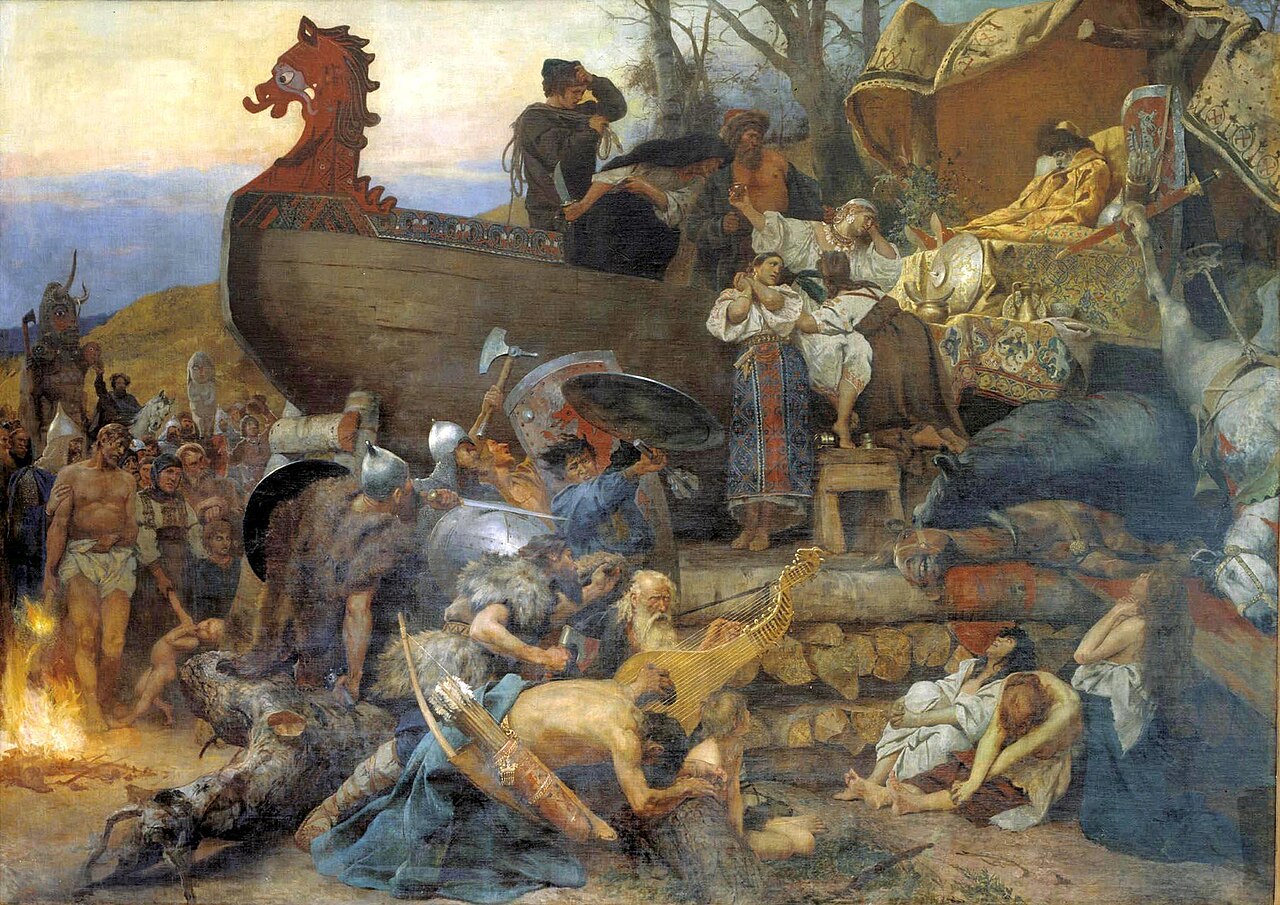
Burial of a Varangian Chieftain, Henryk Siemiradzki, 1883
Siemiradzki's image of a viking funeral is also inspired by ibn Fadlan's account

Last time, I wrote about the characteristics a Viking campaign's setting should have, now I'll spend some time talking about how I plan to evoke the period mechanically and handle some important Viking activities in the game.

I've decided to use GLOG as base system for the campaign, mostly because of the huge amount of class options written for it and how easy it is to hack in good bits from other old school games. Particularly, I'll be taking a lot of inspiration from The Nightmares Underneath  and also some of the rules from Lukomorye.


Classes and Leveling up
In Viking age Scandinavia, the intuitions which controlled power in the medieval period (e.g the Church) were yet to be fully adopted and local institutions (such as the numerous local legal assemblies called 'Things') had less power than the structures which would come later. Power was held more by persons than by structures.

 So, instead of being the member of a class or calling to gain new abilities, you must find a person to instruct you in that class who is a higher level than you. To get fighter 3, you need a mentor who's Fighter 3 already and he can't teach you Fighter 4. Leveling up will probably take a week to a month of training, double that if you're picking up a new class. At home, there will probably be only 3-4 classes available. To find more, you'll need to venture out and interact with the other peoples of the world and find mentors among them. Some classes may be unique, mastered by 1 individual who will not be interested in sharing their knowledge without good reason. Also, having to spend a long time abroad may make achieving mastery of your class difficult. You may find yourself in a place where you are the only Fighter may have to adopt a local tradition if you want to benefit from a level up.

Gaining Experience
Gold for XP makes a lot of sense to use for a Viking campaign, but I think more could be done. For instance, it might be best to give xp when goods are exchanged for precious metals so furs and other valuables can be used to gain levels. Also, I may consider implementing non-combat xp awards so journeys which are commercial failures still have some value to players.

Death, Dismemberment, Retirement 
I'd like characters to retire semi-regularly so that players could try playing the new kinds of people and the new classes they'd discovered on their adventures. Vanilla GLOG usually maims characters instead of killing them, I might move the needle closer to kill or make getting dismembered more debilitating to encourage retirement. Also there should probably be a benefit for retiring characters. Maybe they'll be allowed to level up while retired, manage domains, and return to the game at a later date.

Technology
Most medieval fantasy rpgs assume a decidedly late medieval or early modern level of technology. There's usually a lot of pole arms, sometimes basic gunpowder weaponry, and abundant plate armor. I'd like to keep things  earl medieval, especially in the arms and armor department. 

These will probably be the only weapons: Sling, bow, knife, long knife (basically a short sword), axe, spear, battle axe, sword (a rare status symbol)

In terms of armor, the shield will be the most important piece. It should be subject to breaking frequently too. Body armor, such as the classic leather and chain varieties, should be pretty rare. Most armor will be assembled piecemeal (I'll probably be drawing heavily from Lukomorye's body armor and accessories system). 

Here's some other notes: there is no glass, potions come in waterskins or ceramic jars. There are no lanterns. Your torch creates lots of dirty smoke, candles don't produce much light either. Everything and everyone is generally covered in mud and soot. People live in houses made of mud and straw. In Scandinavia they mixed it up and put the mud on the roof instead to invent the glorious turf roofed house.

Exploration
Wilderness exploration has always been difficult to do well in D&D. The space it takes place in is too abstract, too large, for the usual techniques which make dungeon level exploration work to be successful. There can still be wilderness dungeons which exist on a slightly larger scale than is typical, but trekking through the wilderness should be done differently. I may just rule that the party will need a guide, or perhaps learn the route from another source, to start out on a journey into the mostly unexplored wilderness with random encounters along the way. Still, I'd like the player's to have some freedom in deciding where to go, some chance to stumble across unexpected locations in the wild. 

Exploration by sea will also have to be accounted for. Sailing isn't very interesting by itself, but there should be encounters at sea. I think I'll need pretty robust rules for ships getting damaged and repaired, fighting on deck, and also rules for calculating how much cargo a ship can hold.


Raids and Skirmishes
Raids involve a lot of moving parts. A team of raiders, a settlement with a bunch of buildings, hundreds of inhabitants, a defense force quickly mobilizing, the actually party itself, and a whole lot of chaos. Big skirmishes with 20-50 on each side and pitched battles are not represented well at the scale of D&D combat. Good raiders will avoid this kind of battle, but they still may happen regardless. The whole raid should probably run more like a dungeon, at the scale of 10 minute turns, with the actions of raiders away from the party abstracted to a single dice roll (i.e do they succeed in doing X in the turn) 

A raid may last for hours and see the players going after large objectives, temples, places where goods are stored/produced, treasuries, the homes of the rich, while their team tries to scatter the defending forces and extract valuables from the populace. 

The party may also end up occupying settlements for days, maybe months to continue finding loot or in an attempt to establish the settlement as a beachhead for further raiding and eventual conquest. This will eventually lead to a pitched battle with a larger force of defenders brought in from the surrounding region, the only question is how long it will take for such a force to be assembled. 

In any case, exploration and raiding should make use of a morale system, I'll be using Luke Gearing's. I also need to figure out how xp and gold are distributed among all the members of the raiding party. 

Tribes 
The last time I visited the Meager Country, the different peoples of the Meager Country gained different bonuses from their spirit guardians while the Besharans were divided by religious practice and belief. I'm considering blending these systems together for this campaign.

 For belonging to a certain ethnocultural group you'd get a small bonus but have to abide by certain group practices. For the example, you couldn't continue to be one of the Untamo after violating the sanctity of the sauna, the heart of spiritual life for this particular tribe. Players would usually have no qualms about killing a person in a sauna. They're naked and not on guard, it's a perfect plan. If the violation of a taboo is involved though, and the loss of a mechanical advantage, it may give the players pause. Of course, if we've established that violating the sauna is a grave crime they may exhibit the same pause, but I think using mechanics to underline the importance of these taboos and habits can help get players into the setting. 

Economy
I don't have enough time to do extensive research into the exact value of silver in the Viking age economy and compile accurate price lists. However, I think I'll be able to get away with stealing the great item lists from the Lukomroye player's guide. I'll probably be awarding precious metal by
 weight rather than in coin values at first and use some of the information from Nightmares Underneath to figure the exact value of a gram of silver. I'll also probably be using the inflation rules from Nightmares and the item availability ones from Lukomorye. I may also increase the price of arms and armor by a few fold.  

Institutions 
Institutions are a great place for players to invest money from Nightmares Underneath and would make perfect sense for a Viking age inspired campaign. Though, I will probably have to write more setting appropriate institution types. I think the institutions can also be easily folded into domain play. Here are some more appropriate Viking age institutions. 

Temples, Trade routes (mostly building trading posts), Fortifications (for protecting the trade routes and securing domains), Blacksmiths (for arming large contingents of soldiers), Great halls (for receiving guests and drawing fame), Shipbuilders.

There should probably other institutions which you can learn about abroad (i.e the capital C Church)

Downtime 
I'd like there to be a lot of downtime between expeditions. Winter is long, the season for exploration is short. What happens during downtime will probably be most determined by whether the players are more focused on the world abroad or that at home. There will be feasts and festivals to attend, assemblies and trials to see, and perhaps battles between factions to win or lose. Ships will also have to be resupplied, information about newly discovered routes will need to be acquired, fresh rowers and raiders will need to be recruited.

So that's the rough outline for my campaign, at least mechanically. I'd love to get some other perspectives on what I've presented here, especially the part on tribes.

This post is dedicated to Lawspeaker Torgny, who brought peace with his great harangue 

Sunday, March 31, 2019

An Introduction to the Viking Age

Illustration by Angus McBride of the death of Olaf Tryggvason
 from "The Vikings" written by Ian Heath 


Luke Gearing has been blogging a little about a Viking campaign and it's got me excited. As readers of this blog may guess, I may have a more than passing interest in Scandinavian culture and the Viking Age. Though Luke is right that going a-viking can provide a strong start to a campaign, I've been constantly disappointed by how the Viking age Norse and their world is imagined in rpgs and in broader pop culture. There's a pervasive obsession with the Norse as a warrior culture, some subconscious idea that the raiding which defined the Viking age was the expression of a people whose primary trait was obsession with the glory of battle.

 At worst, this misconception gives us the Norsca of Warhammer, who are just barbarians who want to tear down civilization and spill blood. At best your Norse-themed fantasy civilizations emulate the aesthetics of Viking age Norse culture without replicating any of the historical context. The Banner Saga series of games is a good example of this trend. What you end up with is a series of symbols, runes, round shields, longboats, which are supposed to stand in for some eternal Viking-ness but only symbolize a wholly modern conception of who the Norse were. Granted, vikings are a popular theme in the tabletop space and there are several games which try to offer a more authentic picture of the Norse. Fate of the Norns and the fairly new Sagas of Midgard all try to offer an authentic Norse-ness in one way or another. However, I am still unsatisfied by these projects. These games want to explore Norse myth, more so than Norse history and in doing so sometimes perpetuate the same misconceptions which give us the Norsca.

While I would love to go into depth about the falseness of the warrior culture myth and the mess of misconceptions which accompany it, I do not think I could muster any argument or evidence able to completely overcome this great specter which haunts Scandinavian/Old Norse/Nordic studies. There is no way I can scoop all the romantic paintings of Thor with his winged helmet and all the modern pictures of Odin with a sleeve of runic tattoos out of peoples' heads with a few idle words. However, I can offer a different vision. I can show you what I find so fascinating, so enthralling about the Viking age. Hopefully, I can convince you that a game inspired by the historical context of the Viking age should be about a lot more than just raiding.

Introduction to the Viking Age

The Viking age (roughly 793-1066 AD) was a time of incredible change in Scandinavia and over its' course all of Norse society would be altered. The Viking age saw the first urban centers emerge where previously all of the region had been rural. It saw the rise of the first kingdoms in Scandinavia, the centralization of power to a degree unheard of before. It saw the creation of great trade routes which connected the White sea to all of Europe, the Eurasian steppe, and to the Islamic world. It saw the birth of new colonies and domains far from where any Scandinavian had previously traveled. And, of course, it saw the introduction and victory of Christianity over paganism which rearranged much of Norse daily life.

But trends don't tell us the whole story, they give us the impression that change occurred at a measured pace instead of in fits and starts. There were, for example, several waves of urbanization which saw trading posts built and abandoned before new ones sprang up. Similarly, the conversion to Christianity advanced piecemeal, with champions of the faith, like Olaf Tryggvason, coming to power and later being deposed.

Trends also don't tell us why things happened. The changes which occurred in Scandinavia were driven by a web of circumstances, actions, and reactions. The success of the Carolingian kingdoms probably inspired Norse rulers to construct the earliest trading towns based on the model of those across the Baltic sea. The settlement of Iceland may have been driven by the higher tax burdens imposed by the first king of Norway, Harald Fairhair, which encouraged many to leave the country. There are many factors which could have lead to the increased range and frequency of raids and increased exploration which defined the Viking age. A warmer climate, a growing population leading to a dwindling amount of land allotted to each son, advances in sailing technology, the previously mentioned political changes, all probably encouraged Scandinavians to reach out to the broader world.

Scandinavians found success as conquers mostly in the same places where their raids were successful. The Baltic sea, the British isles, Eastern Europe, the west coast of Europe were all subject to raids and to a lesser extent the creation of Norse kingdoms and settlements. These Scandinavian founded dynasties would eventually be absorbed by the groups they dominated and frequently came into conflict with each other. The nobility of the Rus states, in what is now Russia and the Ukraine, were Scandinavian in origin but began to take Slavic names as time went on. The Normans, also originally Norse, spoke French by the 11th century and clashed with the originally Scandinavian Saxons for control of England. Though raids are certainly dramatic, most of Scandinavia's connections to the broader world were formed by trade not by violence. Saami and Finnic populations provided many of the furs and walrus ivory which formed the heart of Viking age trade routes. Of course, the Arabs, Byzantines, Irish, Carolingians, and English also played a vital role by providing the demand for goods brought by Norse ships. Both Byzantium and the Abbasid Caliphate were victim to a small number of raids, but all were largely unsuccessful. The only way for the Norse to access the greatest riches of the world was through trade, in fur, in amber, in slaves. These trade routes brought massive amounts of silver and lesser quantities of gold to Eastern Europe and Scandinavia, allowing rulers there to line their pockets and better cement their power. The Byzantines also made use of Scandinavians in a military capacity as guards to the Emperor, though the members of this Varangian guard would eventually stop being sourced from Scandinavia.

The raiding, conquest, exploration, trade, and settlement which defined the Viking age were both the cause of and effect of a web of changing circumstances which originated in Scandinavia and were brought to it, which transformed the homeland of the Norse and the world abroad. Though the Norse did often interact with the world in violent ways, it is critical to note that the majority of the cultural and economic relationships they formed were not. It was age when people and places which had never been connected before were drawn into lasting patterns of encounter and exchange. At the forefront of these budding relationships were people willing to risk life and limb, leave the safety or danger of home behind, to pursue gain in the broader world. It was not just the fiercest warriors who succeeded in the Viking age, but those who had the skills to turn a boat full of furs secured from the Finns in Vipuri, into a boat full of silver in the city of Itil, and finally into an army in Denmark able to take power. But not all needed a throne to be happy. Those who settled down in Iceland, Greenland, were just motivated to find a new home, for some the profit motive must have been a draw, and perhaps the call of a yet unknown world was too hard for some to resist.

But the Viking age would not last forever. There were only so many kingdoms to build, so many beachheads to take, so many rivers that lead to the sea. Some would only realize this when it was too late, once they'd already run aground on great sandbars their boats could not overtake. In 913, stranded in a city in Azerbaijan, a beardless youth from somewhere up north took his own life rather than be captured by the forces of the governor Marzuban ibn Muhammad. The party that the nameless child was part of had occupied the city for months, intending to hold it indefinitely. Things were changing in Scandinavia too. Traditionally, power was held together by familial relationships and promises sworn between charismatic rulers and their supporters, but these foundations of blood and bone were to be replaced by ones of brick and parchment. New institutions were being born in Scandinavia, ones which were much more immune to change. Castles and Churches built side by side would replace the old halls and scared groves. In 1066, in an English field, Harald Hardrada was struck in the throat by an arrow. Harald had adventured across the world for 15 years, amassed great wealth fighting wars for Yaroslav the Wise and Byzantine emperors, before returning to Scandinavia to seek the throne of Norway, Denmark, England. Could he see that the strength of his right hand would not be enough this time? Were he and that anonymous boy aware that an entire age was ending with and around them? 

 Change progresses like the tide, going in and out, but slowly reshaping the coastline. Earth is undermined, then falls away. Grain by grain the sand is replaced. In the long view, from up high, it is clear that there is only a slim chance things could turn out any other way, but on the ground, when it seems each transforming wave could be the last, the outcome is impossible to tell. I think this is how it was for the vikings, the explorers, the merchants. Though many would go unremembered, though many would be dashed against the rocks, they could see the world had given them a chance to reach out and hold their own destiny. The pages of history were yet blank, the mortar was still wet on the stones. This is why I love the Viking age. There was still time to write your name or carve it on the walls of the Hagia Sophia. There were still new lands to see full of new people to meet, new faces to kiss, new fruits to eat which are gathered in no other orchard, and new sunrises to gaze upon.

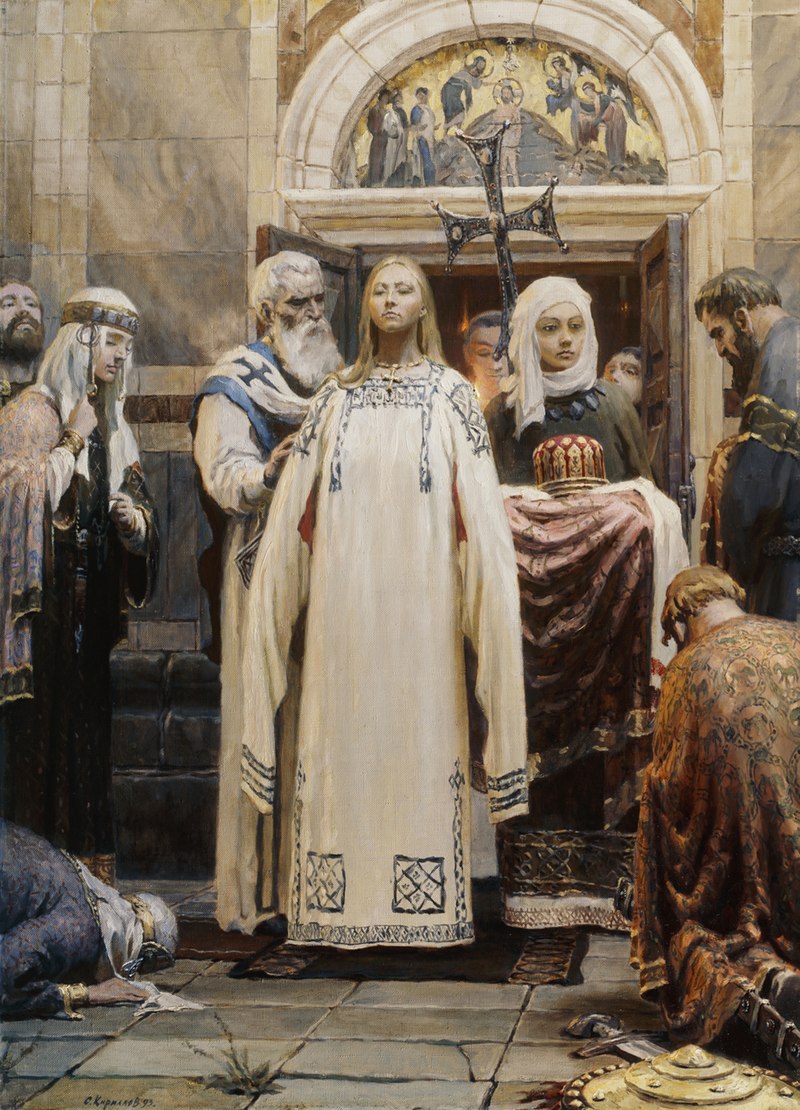
Baptism of St. Princess Olga, Sergei Kirillov, 1993

The Viking Campaign


As we have seen, the Viking age was about a lot more than raiding. If you want to run a proper viking campaign then what matters is not that you preserve a Viking age Scandinavian aesthetic, but play in a world where the historical context of the Viking age is preserved. I wouldn't recommend reproducing the exact circumstances of any decade or century in the Viking age, but rather trying to capture the major and most gamable aspects of the period as a whole. 

The homeland of the player characters should be on the edge of domains which are not immune from raiding or conquest but have superior technology, higher populations, and more centralized authorities. Nearer to the homeland, should be populations able to provide valuable trade commodities (fur, ivory, amber, ect). Forming lasting relationships with these populations can provide steady streams of income, but they'll probably need the party to help them fight their local rivals or send them on a quest. 

Beyond this, the world should be mysterious and mostly unknown. The game's mercantile element should come from having to find the wealthy empires who'll provide the most silver for the party's goods. There will be many trade routes, some dangerous, some full of middlemen looking for tariffs and duties. The elites of the world's empires may also have an interest in the party. Having a group of foreigners with a slightly different attitude towards violence on hand is always useful for those with power. 

 There should also be a kind of adventurer diaspora forming. The party may have rivals who set up kingdoms and settlements close to theirs, compete for access to the same trade routes. The trajectory of the viking game should see the party doing small scale raids and exploratory missions which lead to greater opportunities for profit and eventually transition to more domain focused play, abroad or back in the homeland, in classic old school fashion.    

For players, a viking campaign should be an opportunity to play as a character who is half a rogue trader from Warhammer 40k, a risk taker looking for profit in the unknown, and half Conan the Barbarian, an outsider come to see and judge the heights of civilization.

For GMs, a viking campaign is an opportunity to describe an orange to a character who has never seen one before, to test their player's skills in areas beyond dungeon level problem solving, and to design a political sandbox for players to mess with.

So that's my introduction to the Viking age. I will stress that it is just an introduction. There's a lot more to say about Viking age Scandinavia and its context than what I have presented here is not uncolored by my own reading of history. If you want to learn more about the history of the Viking age, there are many books which serve as deeper introduction to the material than what I provide here. However, I prefer reading the original source material. 'The Viking Age: A Reader' provides a wide variety of sources from many perspectives. I'm a big fan of 'Ibn Fadlan and the Land of Darkness' personally. The doctoral thesis: 'The Rus in Arabic Sources' is also a big influence on the way I see the Viking age. If you want a book with a more rpg focused book, let me recommend 'GURPS Vikings', which does a good job of dispelling common misconceptions about the Viking age.

Thank you for reading this whole thing, hopefully in a few weeks I'll have more details about my own viking campaign  (which will basically be Meager Country v2) ready to show you all.

Hour of the Wolf, Minna Sundberg, 2019

This post is dedicated to that Arch-Lair, that Deceiver, that Great Poet and Preserver: 
Snorri Sturluson

Sunday, March 3, 2019

Welcome to the Ashlands


I took a little break from the Meager Country to write a one page setting, a science-fantasy wasteland ravaged by a war that can't be remembered. Old weapons and old mysteries abound, check it out!


Various Ashlands Visual Inspirations:

Image result for ww1 trenches forests painting

Sanctuary Wood, Cecil Constant Philip Lawson, 1916

Related image
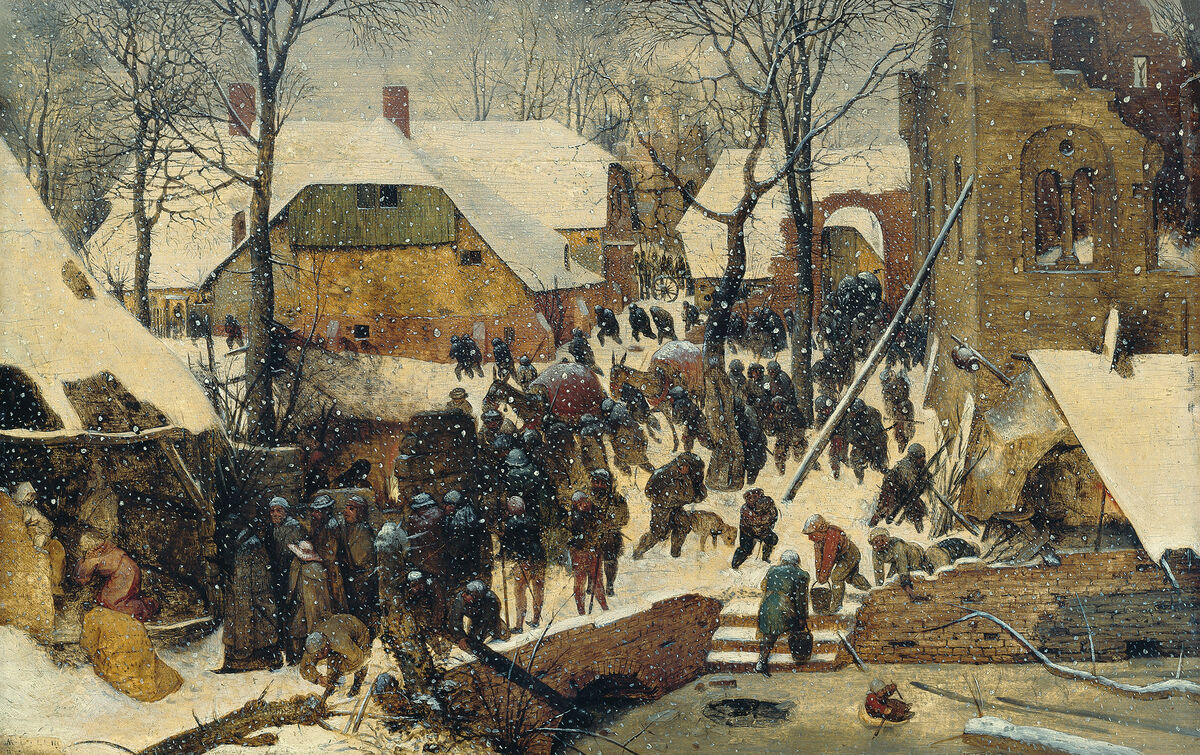
The Adoration of the Magi in the Snow, Pieter Bruegel the Elder, 1563

Entrance to the First Temple of Karnak; a square court, partly ruined, surrounded by double columns of the closed lotus form, covered with paintings and hieroglyphics, near the foreground r an Arab seated on the sand heaped up round the bases of the pillars, one of which has half fallen, another court visible through doorway beyond Watercolour and bodycolour; on buff paper
Untitled (Entrance to the First Temple of Karnak), William James Müller, 1812-1845 

The Forum, Rome, David Roberts, 1835

Moaning Wall, Piotr Jabłoński, 2017

The Menin Road (1919) by Paul Nash, amongst the First World War artists that will be subject of talk in Diss. Picture: Diss Corn Hall
The Menin Road, Paul Nash 1919

This post is dedicated to T.S. Eliot

Saturday, February 9, 2019

Wrestling Rules and Wrestling Tournaments


Whenever people ask me how present authentic feeling steppe cultures in D&D settings I tell them they need 2 things: kumis and wrestling. While kumis is basically a universal across the Eurasian steppe (the Ghuzz Turks of Ibn Fadlan's time certainly drank it), wrestling is more of a Mongolian pastime. From what I've read, there is no evidence that there was any wrestling going on along the banks of the 10th century Volga river, but that should not be a barrier to putting Mongolian-style wrestling in the Meager Country or in any setting where nomads abound.

I've had great success running wrestling tournaments with the rules below. They're adapted (mostly verbatim) for 5e from Joseph Manola's Mongolian wrestling rules (read the whole post if you want to learn more about Mongolian wrestling). It's a great deal more interesting than resolving wrestling matches with contested athletics rolls and provides a fun minigame, a break from the drudgery of combat and negotiations.

Image result for mongolian wrestling art
A painting of the eriin gurvan naadam

Wrestling Rules

To resolve a wrestling bout, each wrestler rolls 1d6 and adds their Wrestling Rating.

-Your basic Wrestling Rating is equal to the sum of your Strength modifier, your Dexterity modifier, and your proficiency bonus if you're trained in athletics and/or acrobatics. 

-Trained wrestlers add an extra +1 to their Wrestling Rating. Being an expert wrestler increases this bonus to +2. Most natives of the steppe are trained wrestlers. 

-If you've studied the technique of your opponent, you may add your Wisdom modifier to your Wrestling Rating. To study an opponent's technique, you must wrestle with them once or watch them compete in two bouts. 

-If you are substantially larger and heavier than your opponent, add +1 to your Wrestling Rating.

-You are expected to have a Supporter (called a zasuul) to yell advice at you, offer encouragement, dispense all-purpose smack talk for the audience. If your Supporter has a positive Charisma or Wisdom modifier, you may add an extra +1 to your Wrestling Rating. If your Supporter is an expert wrestler, you may add an extra +1 to your Wrestling Rating. 

 If one wrestler beats the other's score by 3 or more, then they score a quick victory and their opponent goes down within minutes. 

If the wrestlers' scores differ by less than 3, the match goes long. When the match goes long, each wrestler rolls 1d6 again and adds a modified Wrestling Rating.

-Unless their scores are tied, the wrestler who scored the lowest in the first roll has their Wrestling Rating reduced by 1, to represent their dented confidence. 

-Each wrestler adds their Constitution modifier to their Wrestling Rating, to represent the importance of stamina in the long bout

In the long bout, the highest score wins and a tie indicates a draw, probably because someone bungled a throw and ended up hitting the ground at the same time as their opponent.

Rule Variant: The long, long bout (for those who want more attrition in their wrestling)
In the long bout, you must beat your opponent's score by 3 or more to win. Ties do not result in draws.
If nobody wins the first long bout, repeat the process until one wrestler is victorious.

-As per the first bout, unless the their scores are tied, the wrestler with the lowest score has their Wrestling Rating reduced by 1. This effect stacks

-In the long bout, draws only occur if the competing wrestlers have the same Wrestling Rating and their scores tie.

Tournament Rule Variants
From my limited research, I've gleaned that Mongolian wrestling matches are usually best of 1 affairs, but I find that it's more interesting for the whole party if they all can participate in winning the tournament. 

Teams: Wrestlers do not compete individually, but as part of teams, who take turns in best of 1 matches. The wrestlers who aren't in the match can watch the bouts of their competition to study their technique. If you decide to be one of your team's supporters, you cannot participate as a wrestler. (We may imagine that because the party is made of foreigners they're allowed to compete in a team as a crutch)

Best of 3: Matches consist of 3 bouts instead of 1. (This gives wise wrestler a chance to study their opponent's technique)

But why would you want to compete in a wrestling tournament? Here are some possibilities:

1. Loot. Some local khagan or war leader is offering the spoils of war, perhaps an item the party needs, as the grand prize in a wrestling tournament

2. Respect. The party may have the khagan on their side but they'll never win the trust of the whole community unless they compete in the upcoming wrestling tournament

3. Assassination. A notable person, a thorn in the party's side, is competing in a wrestling tournament. It would be so easy to snap their neck if you can just get a good pin.

Wrestling Titles
You should make sure there are some good titles up for grabs in your tournament. Roll 2d10, one for an adjective and one for a noun to generate a simple title. Let your players write it on their character sheet if they win it for themselves (maybe the opponent they got it from will come to win it back later).

Adjective:
1. Wide
2. Weighty
3. Brazen
4. Mighty
5. Stout
6. Steady
7. Hardy
8. Unstoppable
9. Firm
10. Raging

Noun:
1. Elephant
2. Falcon
3. Lion
4. Bear
5. Horse
6. Champion
7. Hero
8. Bull
9. Wall
10. Yak

Further reading: Here's a clip from the reality tv show Last Man Standing, it shows what a Mongolian wrestling tournament looks like and what a bout between a trained wrestler and a novice looks like.

This post is dedicated to Borte, first empress of the world

Thursday, February 7, 2019

Meager Country Manifesto

Image result for ibn fadlan
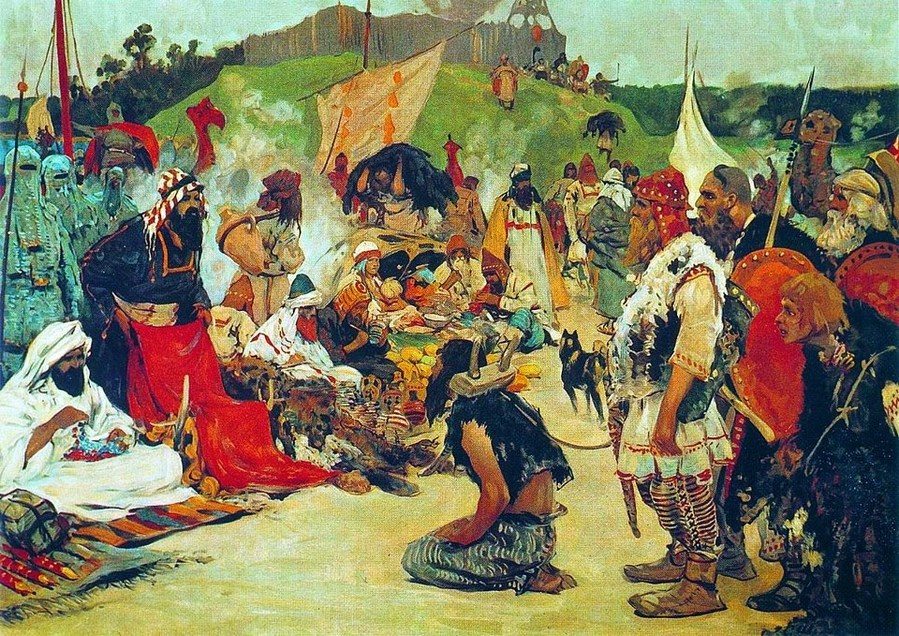
Trade in the East Slavic Camp by Sergei Ivanov, 1913
An image that is always close in my mind when I imagine the Meager Country

As I prepare to run another Meager Country game, I’ve been refamiliarizing myself with the sources that originally inspired the setting. In particular, Ibn Fadlan’s account of his embassy to the Bulhgars as well as the other sources contained in the book “Ibn Fadlan and the Land of Darkness.” Over the course of this exercise, I’ve been reminded of all the things the Meager Country is supposed to capture and all the different directions I could take it. To focus myself, I have written this: My Meager Country Manifesto.

Really, the goal of the Meager Country is to inspire in players a similar sense of danger, strangeness, disgust, fascination, and fear that Ibn Fadlan experienced while meeting the Turks, Bulhgars, Khazars, and especially the Rus. This mix of sensations and the desire to question that goes along with it, I feel, can form the compelling heart of a D&D game.

Of course, Ibn Fadlan is a very unique voice among the small body of documents we have which record the time period I’m interested in. Fadlan’s account is incredibly early (from 922) and he sees things which no other source mentions, like the now classic burning of a Rus leader with his ship.
When other Arabs find themselves in eastern Europe later, such as Abu Hamid al-Andulust al-Gharnati, who started his journey in 1117, almost 200 years after Fadlan, they find a very different world and had very different reactions to it.

Eastern Europe is like a second home to Abu Hamid. There are Muslims and Christians everywhere, the leaders want to learn from Abu Hamid and listen to his shitty poetry. There is nothing to provoke in him that complicated knot of reactions which Ibn Fadlan feels.

In short, I am interested in a time in history that’s as thin as a knife’s edge. The 10th, or maybe even 9th, century which contained a northern world where Islam and Christianity were just beginning to penetrate but had not had any major victories. It was a time when mountains of silver were flowing from Samanid mines onto the Volga to the city of Itil, to the Don river and up, up to Kiev, up to lake Lagoda, up to Birka. Trade was drawing the world together. Alliances between Slavs and Turks and Rus and Magyars with Rome or Constantinople or Baghdad were being formed and faith would cement those fledgling bonds. This is where we find Ahmad Ibn Fadlan, called by the Caliph to bring Islam and 4000 dirhams to Bulgaria.

But the things which moved Ibn Fadlan by their strangeness will not do the same in a modern D&D player. Pluck any person from 10th century Baghdad and show them a Rus merchant and they’ll be seeing something, someone, totally new and unfamiliar. Do the same with a modern RPG player and they’ll just say: “So is this like Vikings or what?”

So Meager Country v2 must be both more historically grounded and more divorced from historical reality. Its world must emulate the political and economic state of the 10th century Arab world, the state which made the journey of Ibn Fadlan to the Bulghars possible, but also be full of new wonders, aja’ib in Arabic, which arouse the same reactions which Ibn Fadlan felt but in the mind of a modern observer.

It’s nice to make nice aesthetic plans but putting them into action, turning them into content is another thing entirely. So what will I do? What will give Meager Country v2 the qualities described above?

1.       Incorporate more Arab beliefs about the far north.
One of the most enduring beliefs about the north in the Arab world was that it was home to Alexander’s Wall, a massive iron gate constructed by Alexander the Great to prevent two races of giants, Gog and Magog, from destroying the world. Such a thing could easily be a ruin left by some fallen civilization, in true OSR style, but it could also be run as a legendary location whose existence is up for debate. I think many of the more eccentric ideas about the north which make their way into Arab sources could be turned into a rumor table and add a layer of doubt to the game.

2.       Add odder folk and folk ways.
I like all the weird kinds of people I wrote for the Meager Country, however I don’t think I emphasized their odd customs enough. I want to get to a point where there’s a sense of culture shock, though I think that might an impossible goal. I should focus more on the strangeness of the different peoples. There should be more odd food, weird rituals players are asked to partake in, more opportunities for faux pas, and I should put players more often in the role of cultural teachers. The Silent Trade will have to mentioned more.

3.       Make travel more dangerous and make stumbling on points of interest more likely.
Though some parts of travel should feel vast and trackless, I want some portions of the game to feature difficult journeys, maybe using wilderness dungeons, or by making use of a deadlier random encounter table. I’d also like to have a high density of interesting locations, maybe by using a few wilderness location tables or just by writing a dense hex map. I could also use some rules for fording rivers.

4.       Focus more on getting from the Empire to the Meager Country
It took Ibn Fadlan a while to just to get to the lands of the Samanids and he visited many cities along the way, he even had to lay low at a little bit. It could be interesting to experiment with starting the campaign as a game about getting the right letters securing passage and greasing the right palms to contrast with the hexcrawling that follows.

5.       Modify what is found in historical sources to create new and evocative content
Just taking things from history is not enough, these ideas must be modified, amended with the fantastic, to strike the tone I want the Meager Country to have. I think that even the fantastic and mythological elements found originally in history should be altered so that some part of them is still unexpected, still unique to the Meager Country.

Now I have a much better idea of what Meager Country v2 should feel like as well as how it will play. It should be a much more player driven game, where there’s less a mission from an imperial authority but just a direction. I think I’ve already been applying some of the above principles, especially #5, but having them written down and codified will help me keep focused on what I want the Meager Country to be as I go forward.

As always, thank you for reading the most idle, content deprived of my musings.

This post is dedicated to Thomas Noonan, who counted coins