Pages

Monday, September 30, 2019

12 Marvels of Science

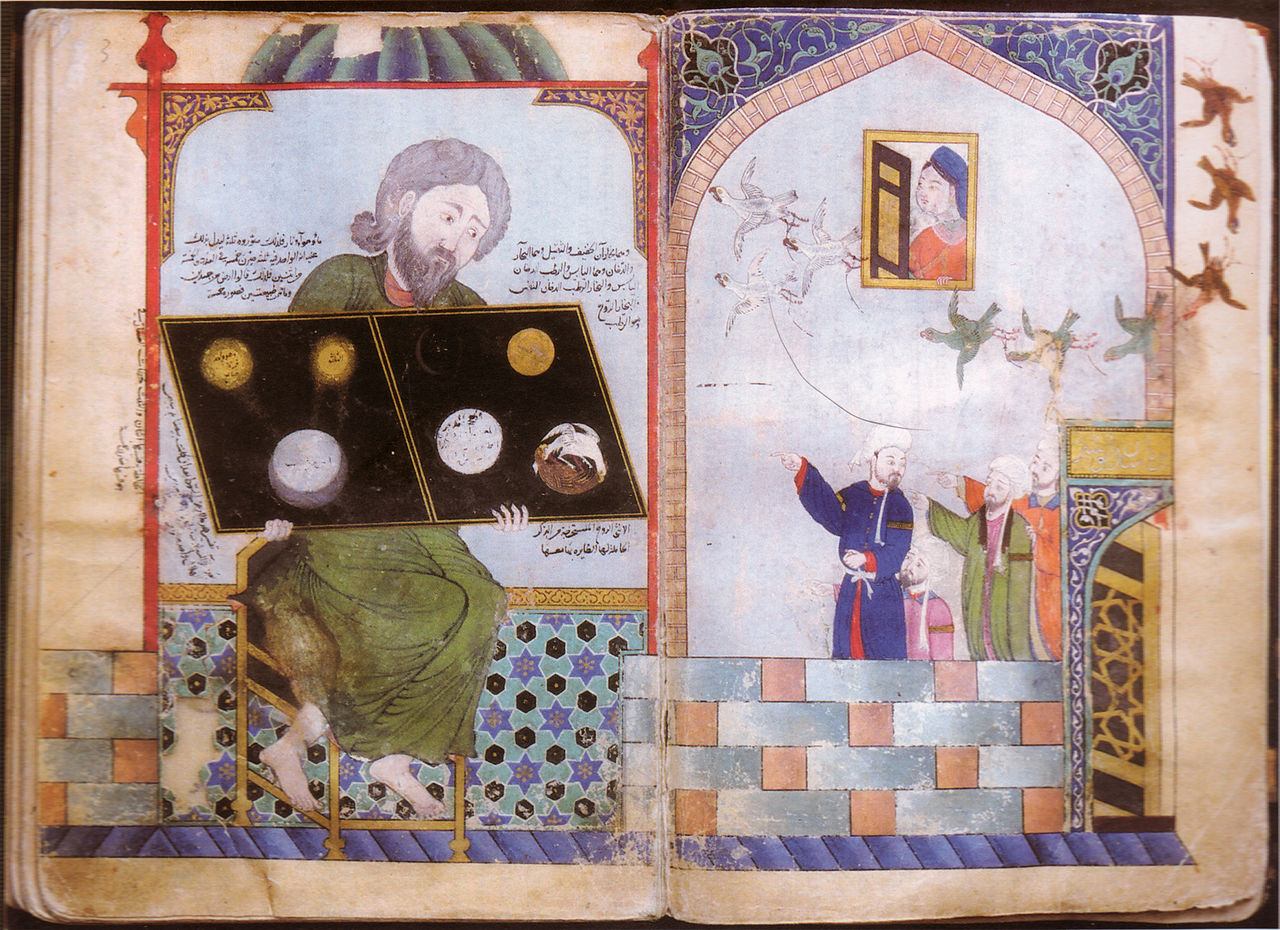
Illustration from a transcript of Muhammed ibn Umail al-Tamimi's book Al-mâ' al-waraqî (The Silvery Water)

Count yourself lucky to live in this day and age. In antiquity there were many marvels, but much was  lost. There was great glory, but it faded and fell away. There was much knowledge, but it was mixed with falsehood. Today we have the Way. As we step from the past into the future, we search for what embers of the old are worth salvaging. 

In 690, following the civil war, ancient treatises on light and the shape of the world and the workings of the organs were brought to the court of the Successor. 719 saw the secret of glass working rediscovered, recovered from the Women who protected it. Now, the Pale Folk study their bodies under the light of the full moon. Blood vessels and nerve endings are mapped, like rivers in a foreign country. Every city has a new hospital and every governor is advised by astronomers and mathematicians, whose fields did not exist a few decades before. Engineers invent luxurious fountains and pump black oil from the earth. The chemists distill tinctures or serums and pass them to physicians for experimentation. Just last year, a cataract was plucked from an old woman's eye, as if by magic. Today I saw a man with an astrolabe, and he taught me to understand the sky. 

There is light and conversation and music in the Successor's house. In libraries and schools creed and sect mean nothing, as all are brought together in the pursuit of what is good and what is true. Barren hills become observations, opening the pages of the heavens. The scribes labor over books and copies of books. They translate from papyrus to paper, from the old languages to the tongue of today. But don't just take my word for it, take a closer look.

 Linger after prayers, hear the dialogue among the congregants. They talk of infinity and space, eternal or finite. Buy sherbet and flavored ice in the market. It is sweet and cold and your tongue has never known its like. And look at these, 12 marvels of our modern knowledge, each an ingenious and extraordinary fruit, plucked from the orchard of the Way, growing in antique soil. 

Each would make a splendid gift, each would fetch a mighty price, each is unlikely to be found or even understood outside the Successor's domain. 


A illustration of al-Jazari's perpetual flute from his Book of Knowledge of Ingenious Mechanical Devices

1. The Spy Glass: A brass tube with several lenses fitted inside. The tube is beautifully engraved with images of (1. Birds 2. Stars 3. Flowers 4. Horses). When held to the eye, the Spy Glass makes far away objects appear closer. The lenses can be removed and used as magnifying glasses.

2. The Water Clock: An unwieldy brass and lacquered wood box with the numbers 1-12 written on it and a small arm set into it. When water is poured into a spout in top of the clock, the arm moves across the face of the clock, from one numeral to the next in the course of an hour, resetting to 1 once reaching 12. The clock must be refilled and recalibrated once a month and can’t function in the cold.

3. The Hydraulic Servant: A small metal automaton dressed like a nomad from the north. It has a control panel on its back and is powered by water. The automaton can be programmed to do simple tasks, such as carrying things, opening doors, or grabbing things but it can only be programmed to do one task at a time. A liter of water is enough to power the automaton for a day, it cannot be operated in the cold. Secretly, the automaton has a little magic within, it cannot be detected as magical but will be effected by dispel magic, anti-magic zones, ect.

4. The Perpetual Flute: A contraption powered by water consisting of two flutes, two water reservoirs, and a tilting pipe into which water is poured. The flue can be programmed to play any tune or even make sounds like speech but quickly repeats itself. A liter of water is enough power the flute for a day, it cannot operate in the cold.

5. The King’s Water: An incredible acid which can dissolve anything but glass. A vial of the King’s Water can dissolve a 5x5ft cube of material over the course of 30 minutes.

6. The Hurricane Lantern: An oil burning lantern made of a wick held in a brass body protected by a glass dome. Its flame cannot be extinguished by winds and it trims its own wick via an ingenious mechanism.

7. The Nostril of Bahamut: A heavy weapon that uses a handpump and tube to cover enemies in sticky, burning oil. The Nostril’s maximum range is 20ft. The oil burns for 2d4 damage a round and cannot be extinguished by water. A burning target can smother the flames by taking a round to stop, drop, and roll. If the Nostril’s pilot wick is not ignited before being fired, it just covers targets in oil. Liquids other than oil can be propelled using the Nostril.

8. 1d6 Naptha Pots: Clay jars full of oil, sulphur, and nitrates plugged with a wick. Several seconds after ignition, the jars explode, dealing 2d8 damage to everything within 10ft of it.

9. The Compass: A magnetized piece of metal suspended in water and laid over the four cardinal directions. It always points north.

10. Physician’s Kit: A box the size of a suitcase containing the latest innovations in medicine. It is full of herbs to treat different ailments and infirmities, smelling salts, acid for cleaning wounds, and soap for cleanliness. A kit has 2d4 charges. Each charge can be used to restore 1 point to a damaged ability score, let a person reroll a save against disease, or restore a creature to consciousness. Additionally, the kit’s charges may have other uses. The herbs are good for cooking, for example.

11. 1d6 Lightning Bombs: Like a naptha pot but filled with pyrotechnic compounds. Explodes in a blinding flash which disorients sighted beings within 10ft of it.

12. The Hollow Needle: A metal tube with a plunger at the back and a sharp piecing tip. The needle creates suction. It can be used to carefully and precisely extract fluids or small objects, such as parasites or contaminants, from the body or just suck up liquid. The effects of potions administered via the needle last 2 rounds longer.

Further Reading: This post is inspired by the Golden Age of Science in the Islamic world, but the inventions on this list are not all accurate to the period. The telescope, for example, was invented in the 17th century in the Netherlands. If you'd like to know more about this period, I'd suggest watching Jim al Khalili's Science in a Golden Age series or just reading "List of inventions in the medieval Islamic world" on wikipedia as a start.

This post is dedicated to Kallinikos, the petroleum consultant 

Saturday, September 14, 2019

Ibn Fadlan is Not an Adventurer: XP Rules for Travelers and Diplomats


The world according to Ibn Sahl al Balkhi, 9th century

So, I've been reading Ibn Fadlan and the Land of Darkness again and thinking more about what an adventurer is exactly. Adventurers acquire things, that's how they level up in traditional D&D, but Ibn Fadlan starts with wealth and loses it. The basic pattern of the D&D adventuring life, starting with not much and working your way up, doesn't fit. Though Ibn Fadlan and Abu Hamid's accounts have been held up as great resources for RPGs, I haven't heard of any other attempts to make campaigns based on their journeys. This is probably because they just aren't adventurers. They are diplomats, travelers. They witness and negotiate and educate instead of taking, overcoming, and ruling.

I don't just want to run a game in a setting inspired by the sources in The Land of Darkness. I want players to act like Ibn Fadlan and Abu Hamid, to be driven to see things and meet people. To that end, I've written new xp rules for travelers instead of adventurers. The rules make a lot of assumptions about the party and their loyalties, but I think that goes hand in hand with the subject matter.

The Arrival of Ibn Fadlan in Bulgary, Urmanche Baky, 1973

To level up, the party must collect Marks equal to their current level + 1. When you level up, the party’s Marks are erased and you start again from zero.

You get Marks for 3 activities: finding wonders, uncovering information which is useful to the postal agency/intelligence service, and diplomacy.

Wonders: The world is full of wonders, aja’ib, mirabilia. Indeed, the stars themselves are wondrous, proof of the infinite variability and glory of the Lord’s creation. There is always a great thirst in court and in houses of learning to hear of new wonders from abroad. We live in age of reason, all wonders must be verified by proper methods. Each wonder found and verified is worth one Mark.

Places: Strange locations in the natural world or significant ruins left by antique civilizations. To verify your discovery, you must determine its exact position and relation to other landmarks using astronomical tools.

Examples: An island inhabited entirely by snakes, a huge dome of lead constructed by giants, an enchanted temple which no mortal can enter, a cave where ice turns to crystal, a sea of pure darkness

Creatures: Unusual or rare animals. To verify your find, you must be able to accurately measure the animal (preferably in cubits) and describe its features in detail from a living or dead specimen. Demons, the undead, and other abominations do not count as wonders. People are also not wonders.

Examples: Mundane animals of unusual size, a hypnotic lizard with crystal flesh, a furry rhino with a huge horn, chimeras of all sorts, huge oozes which blend into the water, ravens with iron talons

Phenomenon: Inexplicable and recurring events which dazzle the mind. To verify your discovery, you must witness the phenomenon thrice in full with your own eyes.

Examples: Armies of jinn who fight in the night sky, a river that turns bright blue when the moon is full, stone elephant tusks that grow in the earth, a huge fish that beaches itself to be eaten daily

Spying: These are uncertain times and eyes loyal to the court are always needed in places far from the Commander of the Faithful’s influence. You must gather information, on both the Successorate's subjects and potential allies.

Governors, Shaws, Amirs: Power must be delegated to keep the Successorate running, but those trusted with that power often have their own ends in mind.

The party will gain a Mark for discovering that:
  • A Governor, Shaw, or Amir practices a heretical religion 
  • A Governor, Shaw, or Amir has committed an act of treason or plans to (e.g. failing to recite the Successor’s name in communal prayers, failing to enforce the Successor’s edicts, or working with her enemies)
  • A group of rebels operates in the territory of a Governor, Shaw, or Amir

Major Factions: Not every tribe of idolaters is of interest to the Commander of the Faithful. Major factions control trade routes, cities, or have access to important trade goods. Be warned, khagans are not above misrepresenting their influence to win foreign favor.

The party will gain a Mark for discovering that:
  • A major faction is trading with a rival of the Successorate (Whose goods do they have?)
  • A major faction has adopted a religion which rivals the Besharan Way (Who advises them, where do they pray?)

Diplomacy: The party represents the Successorate, the Commander of the Faithful, and Besharan Way itself. Adopting the faith and forming an alliance with the Successorate are inextricably linked. Keep in mind that all reasoning creatures, not just people, can follow The Way and may be converted.

The party will receive a Mark for:
  • Opening formal diplomatic relations with a faction and inviting their conversion to the Besharan Way, they will expect gifts from Beshara
  • Correcting the practice of converts to the Besharan Way, converts often continue to practice idolatry
The party will receive two Marks for:
  • Converting a faction's leaders the Besharan Way, they will expect a large gift from the Successor himself, but a lesser religious figurehead can be petitioned to provide the gift

Mark Bounties: Certain objectives have Mark bounties assigned to them, which the party will be made aware of at the start of their journey. Here are some examples:
  • There is a reliable rumor that a Governor has secretly claimed the title of Successor, finding out who will be rewarded with 3 Marks
  • Finding the Iron Wall of The Two Horned Shaw is worth 4 Marks 

Relevant Setting Information

What is the Successorate and the Besharan Way?

The greatest state under heaven. Ruled by the Successor of the Prophetess' favorite assistant, Idris. Rashida adopted Idris into the Besharan people and named him the Commander of the Faithful before she ascended the sacred mountain. For three centuries Idris dwelt in occultation before reemerging to unite the followers of the Way and restore the faith to its roots, founding the tradition we know as the Besharan Way. All the Successor's have been descendants of Idris. The current dynasty are the Nourids, the family of Idris' middle daughter. 

Who opposes the Successorate? (the following list is not exhaustive)

The False Successorate: A rogue faction of Besharan nobility who lay claim to the titles of Idris. They control most of Tamania, but the true Successor maintains rule west of them.

The Way-Universal: A tradition of the Way founded by the Prophetess' favorite companion, Hallaj. There are many streams of the Hallajite tradition, but none is as powerful as the Way-Universal. It is probably headed by the Pontifex Maximus in the Eternal City, or perhaps by the Basilinna in the City of the Constant Emperors. Many kings and rulers follow the Way-Universal and oppose the Besharan Way. Many are interested in the Meager Country.

The Cult of Fire: A left over religion from antiquity. Their practice is not banned but it is heavily discouraged. Lingering loyalty to this old tradition sometimes grips of hearts of non-Besharan Shaws and Governors and its dying influence is still enough to spark troublesome rebellions.

This post is dedicated to Oghuz Khagan

Monday, August 19, 2019

Pipedream Review

In my last post, I mentioned that I wanted to review Pipedream, an investigative roleplaying game written by Kai Poh for the Dream Jam on itch.io. The game is a hack of Cthulhu Dark and inspired by my own investigative ttrpg, Beyond the Fence, Below the Grave. Right now, Pipedream is still in beta but I find that's often the most helpful time to get critical feedback. Let's get into the reviewing.


Pipedream is about a party of Wisefellows, Halfling community problem solvers who smoke copious amounts of the mind altering Elder Weed. Sometimes the Wisefellows just get up to mischief and other times they actually have to stop dark forces from causing trouble or settle disputes within their community. No matter what, they always get high. The world the Wisefellows inhabit is a cross between Tolkien's Middle Earth and the ancient Near East. Irisfields, the setting's take on Hobbiton, is essentially the marshier parts of Mesopotamia. Half of Pipedream is rules for playing as the Wisefellows while the other half is setting information and other tools for generating mysteries to solve and challenges to face.

Mechanically, Pipedream is mostly Cthulhu Dark with extra systems, such as rules for magic, attached. Like in Cthulhu Dark, players try to accumulate advantages and risk their minds to add more d6s to their rolls. Dark's sanity stat is replaced by dream, a measure of how much a Wisefellow's mind has been expanded by their smoking and exposure to the wider world. Dream is cleverly woven nicely into the game's other systems. As your dream increases you get closer to losing your character but you gain benefits from the blend of Elder Weed you smoke and can scupper the investigation to try and reduce your dream as well.

The game is also adamant that Wisefellows cannot fight the larger people and creatures who they encounter without being killed. I think this is a fine choice that puts the emphasis of the game in the right place: on hiding, running, outsmarting. Still, I think this strong mechanical choice can be leveraged better. Knowing that the outcome of an action is death is a lot more powerful if you have a reason to do it anyway. I can imagine that if fighting, though deadly, could provide a brief distraction or something similar you could generate a lot of dramatic moments. Selfless sacrifices, in the vein of 'You shall not pass', do go together with Pipedream's Tolkienian inspiration.

I like Pipedream's character creation too. Players choose character flaws, background information, items, and special abilities all at once. Building an inventory and a character are tied together, as personality details are as likely as equipment to be helpful in getting more dice for action rolls. It's an elegant little system that gives players a lot of freedom and room to express their characters.

My last note on the mechanics is that I find the rules for blending elder weed to be a little too fiddly for such a usually rules light game. I'd be inclined leave rulings about blending the weeds up to a referee instead of writing it into the game, though planting the idea that the weeds can be mixed in the players' heads is a good move.

Irisfields is fascinating in the ways it tries to emulate and undermine Tolkien's own secondary world. Irisfields is more morally gray, light and dark alignments are not guarantees of good or bad behavior. The community the small folk live in is far from an innocent and idyllic Hobbition. Instead, Irisfields is full of greedy landlords, untrustworthy sheriffs, and unreliable Wisefellows. All this, of course, makes the setting a much more interesting place to solve a mystery in. This social dysfunction is probably what is borrowed most from Beyond the Fence. Though both games feature communities beset by dangerous outside forces, those communities were already full of their own problems in the first place.

Though I like a lot of the referee facing tools, I feel like some things are missing. The bestiary is great, all the entries feel mundane and fantastic at once, like they're all part of an ecology but still tinged with magic. The adventure seeds for each region of Irisfields are simple and effective little mysteries or dilemmas, I'd just like to see more of them. There's lots of information on the kinds of big folk in the world but there's no suggestions for why any of them would be in Irisfields, beyond the few big folk mentioned in the adventure seeds.

 What seems to be really missing is a table to cover the non-investigative half of Pipedream: causing mischief. Here's a good suggestion from earlier in the document: "Let’s say you actually want to solve a case instead of, say, trying to squeeze as many goats as possible into the Mayor’s bedchambers before he awakens." I would love to see a table of similar gambits, pranks, wagers for Wisefellows to busy themselves with.

Lastly, my art gripe. The public domain art in Pipedream is nice but a lot of the images look like they're drawn on paper.

This lovely drawing of a pipe shows up several times in the document and it is always surrounded by this papery shadow which is just sightly different from the background. Here is a tutorial for fixing this issue using photoshop, and here's one for inkarnate.

Overall, Pipedream is a game with a simple, smart set of mechanics, great character creation, and a fascinating setting to explore. I'd say it's main strength is how the carefree whimsy of the Wisefellows and their adventurers can turn so quickly grim in the face of malevolent outsiders and internal conflict. The game is narrow in the sense that it is about a few very specific people in a very specific place, but the range of tones it wants to convey is excitingly broad. It could still use a bit more development, but I'm sure that development will come. You can buy Pipedream on itch.io.


This post is dedicated to the Niflungs

Monday, August 12, 2019

Dreams and Fevers Turns One!

Piece of Cake by Joy Argento

Last year on August 12, I uploaded my first post to this blog. 'Hello All!'

The passing of the year has got me feeling reflective. I'd like to take some time to consider what I've been aiming to do with this blog. I'd also like to celebrate a little and express some gratitude because this is an anniversary, but it's a delicate balance to strike between thanks and false humility, careful pride and self congratulation. Let's see how I do.

"Blogs shouldn’t be conversations. They should be writing."

As G+ was going down, I shared this blog post by Chris Warley there. It's a post about the consequences of speed, how email and texting and twitter shape the kind of discourse which occur through them. It's about how complex topics demand that we slow down to understand them. It's about the value of reading, of paying attention, of taking one's time. It's about how going too quickly, having too much data to sort through, destroys our ability to understand what we're looking at. It's also about Italian food, but I digress.

I happen to agree with Chris, but he's an English professor. He's trying to understand Adorno and Donne. I'm trying to get prepped for my game this weekend. But I think often about Chris' post and about what I'm trying to do here. Though rpgs may be less complicated than literature and critical theory, that is not to say they are simple. Thinking about them, about system and aesthetics and rulings, in a way which is useful to playing the game also requires a speed which is not as slow as academia or as fast as an exchange over twitter.

Up to this day, I think Straits of Anián is the best D&D blog out there. It hasn't updated since 2014 but I keep coming back to it. Each post, especially We are Eaten Forever, feels complete, rich, and dense. It starts with one idea, devouring spirits, and expands to rules for soul loss, rules for possessions, a warrior society, a whole bestiary of cannibal monsters. I feel like Straits' posts are worth the close attention of reading and rereading, they are slow blog posts.

I probably won't ever run something pulled straight from Straits (except those possession rules, they're great), but I won't forget it either. I find that I don't read blogs to rip things directly from them into my games but to be constantly inspired by them. I probably won't have one of Zedeck Siew's Priests of Want at my table, but I want my Devouring Priests to capture the same sort of terror.

When I write here, on Dreams and Fevers, it is Chris' slow ethos that I follow and Straits' standard of richness that I try to achieve. I want to write things which are worth rereading as much as they are worth using at the table. When I place that dedication at the end of each post I want it to be well earned. I don't think I've always lived up to that standard. I've hit 'publish' on drafts that were a bit too rough, refused to cut for concision too often, but I've gotten better too.

 At the same time, I've been stretching myself into areas where the same standards aren't as applicable. I've written a review and a one page setting, essays and a manifesto. So Dreams and Fevers has changed a little, but I try to keep the same goals as mind even as what I write changes. Richness, completeness, rereadability, slowness. I doubt that these goals will always be fit to the task at hand, but having them close to heart has never hurt.

As I go forward, I want to write more dense, Straits-esque posts while still trying new things. Again, another tricky balance to strike. Maybe I'll try going a tad faster this year, maybe even slower, the future is never easy to describe. All I know is that I'm looking forward to what comes next, be it continuity or change or something else.

Hornsgaten by Night by Eugene Jansson

So that's it, that's me. A lot has changed this year. I'm happy to have made it this far. Thank you all for coming along with me. Special thanks to those of you who have never commented or made yourselves known but just read, I know you're around somewhere and I'm grateful for your silent attention. Thank you to everyone who has put me on their blog list or linked to one of my posts, I appreciate that vote of confidence.

Finally, thank you to everyone who's been inspired by what I do here enough to start their own blog or undertake their own project. Thank you Kai Poh for writing Pipe Dream (which I'll get around to reviewing eventually). Thank you Gundobad for all the excellent posts about history and rpgs. Thank you Paperweight for Akavan. Thank you Lexi for starting A Blasted, Cratered Land, which constantly impresses me. And, finally, finally, thanks to Joe Fatula and Boris Stremlin, who have made a great impression on me.

This is a lot of thanks for just one year on just one small D&D blog, but this is how I feel. I look forward to the next year of Dreams and Fevers, I hope that you do too.

This post is dedicated to Thomas Ligotti

Wednesday, July 31, 2019

Cowboys and Conquistadors: Looking for New Models of the Adventurer


Tlaxcalans and Spaniards enter Guadalajara, image from the Lienzo de Tlaxcala

Dungeons and Dragons is about adventurers. A D&D campaign consists of a string of adventures with downtime stretched between them. These ideas didn't come from nowhere. In his 3 part essay, The Sociology of the Murderhobo, Boris Stremlin explores the literary roots of the adventurer, as they are portrayed in D&D, and looks for a model of the adventurer not as a literary archetype but as "a social type" which emerges in early modern history.

In my opinion, Stremlin's essay series is one of the best fruits of the D&D blogosphere. It's articulate but not too inaccessible, well argued, and reveals both the interesting history of D&D and new ways of playing it. Though D&D owes much of its original conception to literature, Boris' analysis suggests that the fantasy of D&D is far from a-historical. The genres which inspired D&D (Weird Fiction, Sword and Sorcery, and Heroic Fantasy) all take influence from the historical and cultural context from which they emerge.

Boris finds that the literary forebears of D&D, in one shape or another, reflect the history of colonialism. The protagonists of Sword and Sorcery are strongly reminiscent of Cowboys from American Westerns. The protagonists of Weird Fiction confront "the immigrant, the politically mobilized but still undereducated industrial worker, the native" as often as they do the cosmic. Though Boris does not touch on the legacy of colonialism and race in Tolkien's epic fantasy, the connection is not difficult to make. (Sidebar: Though James' article explains the history of Tolkien's Orcs well, I feel that he draws too harsh a division between Europe and the steppe. There is a rich and complicated history of interaction between nomadic and sedentary peoples in Eastern Europe.)

All these genres also employ a distinction between a civilized zone, where protagonists hail from, and a frontier where the main narrative action takes place which makes a heavy impression on D&D. In Westerns and Sword and Sorcery this divide is most literal. In Weird Fiction these are frontiers of knowledge as much as physical spaces. The position of Rangers in Tolkien's books attest to a border existing between two civilizations if not between civilization and frontier.

4th edition's so called 'points of light' setting operates on the assumption that the world is composed mostly of "wild, uncontrolled regions" with city states between them. Similarly, in the very title of Gygax's Keep on the Borderlands the same dynamic is represented. There's a Keep, civilization, and the Borderlands, the frontier. Granted, not all D&D settings and adventures maintain a frontier vs civilization theme, but it's telling that this theme stretches from a core assumptions of a modern edition of the game right back to a module intended to introduce new players to it.

Though the legacy of colonialism is certainly sanitized in D&D, it is still present in the game's basic ideas. When we tell stories around the table of civilized heroes venturing beyond the borders to beat back the forces of chaos again and again we should take pause and consider what kind of narrative we are participating in. I'm certainly no less guilty of doing this than anyone else. Boris himself has pointed out how I project the frontier/civilization division onto my own Meager Country.

The connection between D&D and colonialism is also not new. I've begun with Boris' essay but others have reached similar conclusions by different means. But the question remains: in light of this, how should we change the way D&D is played?

 I think we need to base our campaigns off different types of adventurers who are not cowboys or conquistadors and we can find such figures in history. We need to look to the past for new stories, new protagonists, different relationships between 'civilization' and 'frontier.' This effort will not just remove a problematic element from the game but broaden the horizons of what can be represented at the table drastically.

4th Centruy Goth Warriors, Angus McBride

What is an adventurer? 

As Boris describes in the second part of his essay, the early modern adventurer is somebody who manages risk, be they a mercenary, merchant, or financier. The adventurer exists in a time of social change. Established hierarchies are starting to wobble. Great opportunities for disaster and success are emerging. The first adventurers were also the first colonizers. Hernán Cortés, Samuel de Champlain, and John Winthrop fit the word well. But Boris draws our attention to other kinds of adventurers through his discussion of the Ashkenazi Jewish diaspora. This group doesn't appear to be very adventuresome when stood beside the conquistador, but commonalities soon emerge. The Polish-Lithuanian Commonwealth of the 14th-16th centuries, still developing and capable of offering greater religious freedom, is certainly a kind of frontier. Managing a business and setting up a community far way from one's home certainly requires a skill in managing risk. So an adventurer is not necessarily a colonizer and a frontier is not necessarily a terra nullius. 

What we are looking for is this: other conditions under which the adventurer as social type can exist. We are looking for groups of people who choose or are put into situations which require the management of risk to protect their communities or to move up the social hierarchy. These adventurers will also exist in times of change, whose outcome may depend heavily on their choices, failures, and victories. The frontiers they venture to may be states in crisis, far off lands in need of expertise of all kinds, or regions where valuable resources can be obtained.

Here are a few examples of good models of the adventurer, most drawn from the excellent Gundobad Games blog.

The Sea People (and others) of the Late Bronze Age Collapse

The international order of the Late Bronze Age relied on trade and communication between rulers facilitated by mobile populations. Such populations had great power to support or subvert the social order and can be easily seen as adventurers.

The Visigoths of the Late Roman Empire

The Visigoth were one of many groups forced into Rome's borders by the advancing Huns. The Visigoths faced great challenges in the form of corrupt Roman officials and anti-barbarian politicians as they became more and more integrated into the empire. A campaign based on this period would see the player characters adventure to ensure the safety and continuity of their community in exile.

The Vikings of the Viking Age

The Vikings traded, raided, and explored all the way from the White sea to Constantinople and beyond. Driven to win social status back home, pursuing economic advancement, and stimulating change at home and abroad makes the Vikings fit the model of the adventurer almost perfectly.

These are just three examples but in them is an incredible diversity of campaign concepts. I feel like D&D could have been founded on any of them as easily as on fantasy literature. But more remains to be discovered, more models await discovery by game masters who can pay careful attention to history.

This post is dedicated to Marshall Hodgson

Thursday, July 18, 2019

An Introduction to the Prophetess and the Way

Illustration of Canto 34 of Paradiso,Gustave Dore, 1864

How many countless hundred thousands pray
For patience and true knowledge of the Way
That leads to Him whom reason cannot claim
Nor mortal purity describe or name;
There soul and mind bewildered miss the mark
And, faced by Him, like dazzled eyes, are dark -
No sage could understand His perfect grace,
No seer discern the beauty of His face.
His creatures strive to find a path to Him,
Deluded by each new, deceitful whim,

-The Conference of the Birds by Farid Ud-Din Attar

The Master said, "When a person's knowledge is sufficient to attain it, but his humaneness does not allow him to hold on to it, he may get it but will inevitably lose it again. When his knowledge is sufficient to attain it and his humanness allows him to hold on to it, but yet he cannot govern with dignity, the people will not respect him. If his knowledge is sufficient to attain, and his humanness allows him to hold on to it, and he governs with dignity yet does not act in accordance with the rites, it will still not be good."
-The Analects of Confucius, 15:32

First there was the Lord. He is ultimate, good, merciful, terrifying, other, universally sovereign. He created all that is on earth and beyond it. He shattered his infinite being to do so. The Lord adheres in the whole creation, each part contains a grain of His infinity and the perfection of His Holiness. But all things are also separate from their maker. Everything is doomed to stray from Holiness. Self and selfishness, greed, indulgence, pride and vice arise where the essence of the Lord is first removed from Him.

 Between us and He is the Gate. The Gate is separation, the border between the world we see and the one we don’t. There may be goodness, courage, bravery, humility, but if it does not cross this threshold and return to Fullness with the Lord, it will rot away. 

 The first to turn their backs on the Lord were His Archons, the First Ones, who inherited the greatest share of Holiness. They were charged with maintaining the creation, but resentment was born in their hearts. They wished to govern their own domains where they would wield the Lord’s sovereignty as their own. They became the gods of the earth and they ruled it as tyrants do. Under such cruelty, the people of the world strayed from Holiness and they turned on each other. Animals, plants, and finally the earth and water and air followed them. War, disease, famine, disaster. These are the fruits of the Traitor-Archons’ dominion over the universe.The Traitor-Archons did not fear the Lord. They trusted the Gate to keep the cosmos in their sway. The Archons placed their fingers over it to hold it even tighter.

Despite the Gate, the Lord still holds power in the cosmos. In old Beshara He was regarded as a deity of law and contracts. He elected prophets, people who would bring the nations of the world back to Holiness. None of them overcame the Gate, but they all foreshadowed greater things to come.

File:Beatrice Addressing Dante (by William Blake).jpg
Beatrice Addressing Dante, William Blake, 1824

When she arrives in the First Holy, the Book of Hallaj, she speaks from the background, among the craftsman and fishermen and shepherds. She is already old because she has wandered long years in exile. Her ear is pieced. It is a reminder that she was once property of the great chieftain ‘He Who Kills with a Glance.’ Her eyes have been cut out, for she spoke up for the bastard child abandoned in the desert and the supplicant denied justice in the court of Hujuz.

She calls herself Rashida. We know she is our Prophetess. She is one of the pale people of Beshara. The Lord came to her in the heart of the desert. All her wandering had led to Him, barely to the foot of His throne. He struck no covenant with her. He reminded her of Him. He gave her a phrase: ‘the Way.’

Her voice is always the same, no matter which scribe records her. She holds the Way in her mouth like a banner. She speaks with passion for the Lord and the Way, which is His gift to all the world. Her lips form graceful sentences in the old Besharan language, interlaced with the rough syllables of the tongue of the Bauda people. She denounces the world as it is, ruled by the tyrant pawns, the servants of the Traitor-Archons. 

The Way is the Lord’s plan for the creation. The Way is the formula that leads us through the Gate. The Way returns us to goodness, then to Holiness, then to Fullness with the Lord. Without it, no virtue and no truth can last on earth or beyond it. Some believe that Rashida opened the Gate herself once she ascended mount Arsir and left the world, ensuring that we could follow her. Others believe that she just slipped through the keyhole. You see, the Gate might only open from the other side and when it does only those who know the Way will be let through. 

The Way is a relationship. The creation is truly one with the Lord and it all must be accorded the respect He commands. 

The Way is a belief. It is the conviction that the self and the world can be redeemed through their own will and action. 

The Way is a practice. To stray from Holiness is our natural condition, but ritual keeps the Way in the foreground of our life and Fullness as our goal. 

The Way is all encompassing. It begins with a woman, it embraces the world. It begins with a word and a full sentence rises from it. It begins with one order of creation, the people of earth, and will move to bring the entire cosmos back to Fullness with the Lord. There is no person, no thing, no place, no time to which it is not relevant. 

The Way is a challenge. It demands our attention; it demands we bend our lives around it. It will be the measure of your deeds, your thoughts, and the deepest feelings of your heart. Your family, your community, your city, and your entire society will be held to account by its standard.

Though our responsibility to the Way and to each other weighs heavy on us, we can be assured that as long the as the cosmos retains its essential Holiness the Way will retain its infinite efficacy. But much remains unanswered. What exactly is expected of followers of the Way? What is forbidden? What will be redeemed and what will be destroyed? To whom do we pray - To the Lord? To the Prophetess? To the Way itself? When we fail in our pursuit of Holiness, where do we turn? What will a cosmos returned to Fullness look like? Is the Gate open?

Girl Reciting Qu'ran, Osman Hamdi Bey, 1880

We seek answers in the life of the Prophetess, as her voice comes down to us in the Five Holies. The books of Hallaj, Laila, Emrah, Idris, and the book of Attestations lay bare the deeds of the Prophetess and the knowledge of the Way which she imparted to her earliest assistants. We are reminded that Hallaj was once the Prophetess’ greatest opponent before his conversion. We are filled with hope. We read the tender words spoken between Rashida and Laila before they fled their enemies. We shed tears, knowing that the Way is not easy. Emrah recalls the judgments which the Prophetess gave at the city of Unah. This shows us that the Way sometimes requires as much pragmatism as conviction. Idris watches his Prophetess climb mount Arsir to leave this world behind. His grief, his awe becomes our own. We read the squabbles which occur amongst the assistants as the Prophetess shares her wisdom in the book of Attestations. We sigh, knowing that learning still escapes us.

Aged, pieced, blinded. Slave, serving girl, exile, teacher, judge, leader, Prophetess. 
Wandering, seeking, losing, finding.
Perspective, thought, belief, action. 
Self, community, society, cosmos. 
Pilgrims, commanders, merchants, mystics, princes, servents, farmers, nomads, governors, fishermen, basket weavers, artisans, scribes, builders, scholars, canal diggers, herders, parents.
All of these are joined in the pursuit of the Way. Like a canto being spoken or a tapestry woven, the Way continues on. Tomorrow may be a step toward Fullness or a stumble back to separation, but the Way will continue all the same. 

Our history stretches almost 800 years. Struggle has shaken and divided us. Compromises have been made. Power and the Way are so tangled as to be inseparable. But the spirit of our enterprise remains. The Way is strong, the Way is true, and we continue to rise to its challenge. 

St Francis with a Skull, Francisco de Zurbaran, 1630


I’ve touched on the religion of the Besharan empire before and made it a major mechanic in my last Meager Country campaign. However, I don’t think that last set of rules gives the right impression of the Besharan religion. All the sects seem like their own faiths with wildly different practices, rather than different expression of the same rich and varied religious tradition. I think my players had the same feelings. 

With this post, I wanted to take things from the top and give all the sects a more solid background to work off of. In future, I'll be add more posts detailing the sects and eventually circle back to writing more mechanics for playing priests and paladins and mystics of the Way. 

This post is dedicated to Rabe'eh of Basra

Saturday, June 29, 2019

Fall at Old Uppsala - and a Beyond the Fence post mortem


It's done! The first scenario published for Beyond the Fence, Below the Grave is up on itch.io!

You can download it here! 

It's been really fun play testing the system and developing this scenario for it (which, in my honest option, is the best scenario ever written for Beyond the Fence!). Now I have a much better sense of how the system performs. I wrote it partially because I wanted to explore the Old Norse milieu in more detail (and also because of the folklore jam) but also because I wanted to apply OSR design principles to a game without a dungeon. I'd say that it's been a success. The system's rules are flexible and welcome improvisation. The focus on investigation is a good substitute for the dungeon, probably because players succeed in both situations by asking the right questions.

On the whole, I'm impressed by how engaging Beyond the Fence can be for both players and GMs.  The dropping essence scores keeps the tension building. The need to perform a crisis ritual helps the players stay focused. I've had parties fail while running Fall at Uppsala and others succeed and each time it's been a pleasure to watch them bend under the pressure and try to put all the information together at the last minute.

The system needs a good scenario, with high stakes and dense mystery, to function but when it does it's really, really good. If it has a major issue, it's that the system is a one trick pony. It doesn't have a way to make investigation #6 different from investigation #1 and I have no clue what a Beyond the Fence campaign would look like. I'm also worried that I demand too much familiarity with Old Norse society and mythology for the game to be accessible, but I'm trying to remedy that by adding some basic notes on historical context to everything I publish for Beyond the Fence.

Right now, I feel that each of the specialties could use more play testing, but the potential of Beyond the Fence is still great. There are many more parts of the pre-medieval Scandinavian world that I want to represent in the game. I want to explore trading towns and the borders of Saami territory and shores of a just settled Iceland. I want to write about the concubines of jarls and Muslim merchants in the north and about more fishermen and upstart raiders and farmers.

So the first scenario is done, but there are many more to come!

This post is dedicated to Gustav Strom, translator of Heimskringla